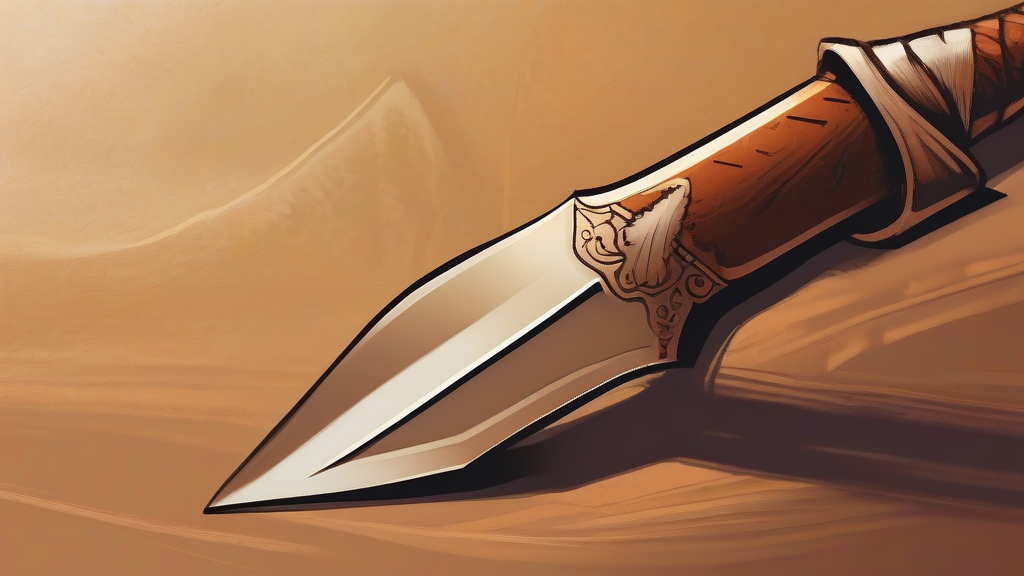
What does daggerlike mean?
Daggerlike describes anything that resembles a dagger — something long, narrow, sharply pointed, and often threatening in appearance or effect. As a descriptive adjective, it is applied both literally and figuratively. Literally, it suits slender pointed objects: daggerlike leaves, daggerlike towers, daggerlike shards of ice, or the daggerlike beak of a heron. Figuratively, it captures hostility or cutting intensity, as in a daggerlike stare, a daggerlike remark, or a daggerlike pang of pain. The adjective derives simply from the noun dagger combined with the common English suffix '-like', which forms resemblance adjectives such as childlike and lifelike. Because of its association with weapons, daggerlike carries a distinctly menacing connotation, which makes it a vivid choice for writers who want to convey danger, precision, or emotional sharpness without naming an actual weapon. It belongs to formal and literary register rather than casual conversation, appearing most often in descriptive prose, nature writing, journalism, and fiction where visual imagery matters.
adjectiveResembling a dagger in shape, sharpness, or character; long, narrow, pointed, and often menacing in appearance.
- Resembling a dagger in physical shape — long, narrow, and sharply pointed (e.g., a daggerlike leaf, blade, or peak).
- Resembling a dagger figuratively — piercing, hostile, or wounding in effect (e.g., a daggerlike remark or stare).
"She gave him a daggerlike glare that silenced the room instantly."
"The agave's daggerlike leaves bristled along the garden wall."
"He delivered the criticism with such daggerlike precision that she never fully recovered."
"Daggerlike" turns any noun into an insult or a weapon — from a daggerlike glance to a daggerlike mountain spire, it's the adjective equivalent of drawing steel.
Reviewed by Deb Chak, Editor. AI-assisted content curated by RJS Tech Solutions LLP.
Etymology of daggerlike
Daggerlike is a straightforward English compound formed from the noun dagger plus the suffix '-like', following the pattern of established resemblance adjectives such as childlike, lifelike, and warlike. The noun dagger itself entered English from Old French 'dague' in the late medieval period, though the deeper origin of that French word remains uncertain. The suffix '-like' has been used since Middle English to build adjectives expressing resemblance, giving daggerlike its transparent meaning of 'having the form or quality of a dagger'.
How daggerlike is actually used
Daggerlike is used almost exclusively in descriptive and literary writing rather than everyday conversation. Its connotation is typically menacing or cutting, whether applied literally to shapes or figuratively to looks and remarks. It appears more often in British and American journalism and fiction than in casual speech.
Easily confused with daggerlike
A dagger is the actual short pointed weapon, whereas daggerlike merely describes something that resembles one.