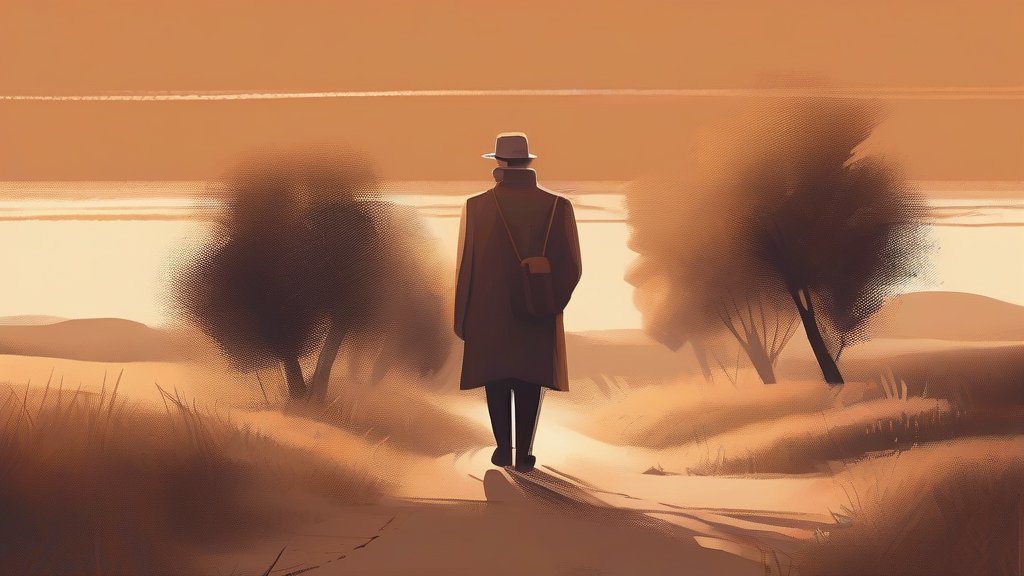
What does dandering mean?
Dandering is the present participle of the dialect verb 'dander', meaning to walk or wander about in a slow, easygoing, purposeless way. Heard mainly in Ireland and northern England, it describes exactly the kind of unhurried strolling in which the journey itself, rather than any destination, is the point: someone might spend a Sunday afternoon dandering around a market town, drifting from shop to shop with no plan at all. The word belongs firmly to informal speech and carries a genial, affectionate connotation — it suggests contentment and idleness rather than restlessness. It is closely akin to standard words like 'strolling', 'rambling', and 'sauntering', but its regional character gives it extra charm for those who know it. For visitors to Belfast, Derry, or Yorkshire, hearing that someone is 'out dandering about' signals a relaxed, unhurried mood that no more formal synonym quite captures.
verb (present participle/gerund)Dandering means walking or wandering about in a leisurely, aimless way. It is the present participle of the chiefly Irish and Northern English dialect verb 'dander'.
- To walk about in a slow, leisurely, aimless manner; to stroll without any set purpose or destination.
"We spent the afternoon dandering around the old town with no particular destination in mind."
"He whiled away the morning dandering along the canal, stopping now and then to watch the boats."
"Rather than heading straight home, they spent the evening dandering through the Christmas markets."
In Ireland and northern England, you don't just stroll — you 'dander', a word that turns an ordinary walk into a small act of doing absolutely nothing in particular.
Reviewed by Deb Chak, Editor. AI-assisted content curated by RJS Tech Solutions LLP.
Etymology of dandering
The verb 'dander', from which 'dandering' derives, is recorded from the nineteenth century in Scottish, Irish, and northern English dialect, though its ultimate origin is uncertain. Some lexicographers connect it to an older dialect noun 'dander' meaning the head or a walk, while the unrelated noun 'dander' meaning temper (as in 'get one's dander up') is of separate American origin, possibly from a West African source via Dutch-American usage. The walking sense remains alive today primarily in Hiberno-English and northern British speech.
Related word forms
How dandering is actually used
Dandering is informal and strongly regional, heard chiefly in Ireland (both Northern Ireland and the Republic) and in northern English dialect. It carries warm, affectionate connotations of unhurried idleness rather than being lost or restless — to be dandering is to have nowhere in particular to be and to be perfectly content about it. It would sound out of place in formal writing.
Easily confused with dandering
The noun 'dander' most commonly means either loose scales from the skin/hair of animals or, in the idiom 'to get one's dander up', a fit of anger, whereas 'dandering' refers only to leisurely aimless walking.
'Pandering' means gratifying or indulging someone's desires (often with negative connotation), which sounds similar to 'dandering' but has an entirely unrelated meaning.
'Wandering' is the standard, general term for roaming without fixed course, while 'dandering' is a regional dialect word carrying a distinctly relaxed, unhurried flavour.