
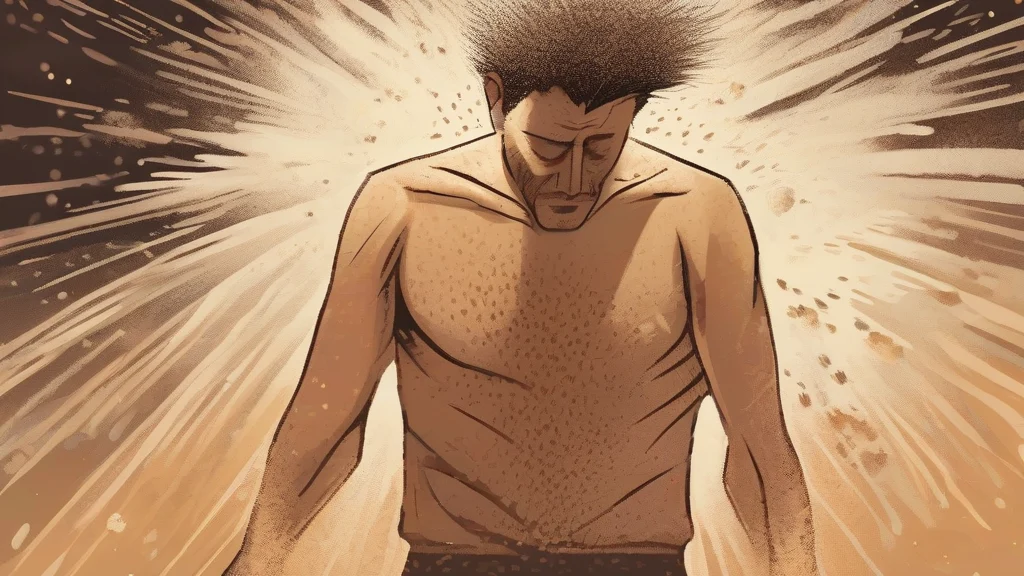
What does dandruff mean?
Dandruff is an uncountable noun referring to the small flakes of dead skin that shed from the scalp, frequently accompanied by mild itching. It names both the flakes themselves and, by extension, the common and harmless scalp condition that produces them. Dandruff is most noticeable on dark clothing and hair, which is why it has long been associated with personal grooming and appearance; this gives it a slightly embarrassing connotation, though medically it is simply a form of superficial skin shedding linked to factors such as dry skin, sensitivity to yeast on the scalp, or seborrheic dermatitis. In everyday use it appears chiefly in health, beauty, and advertising contexts — one buys dandruff shampoo, seeks a cure for dandruff, or brushes dandruff off a shoulder. A rich vocabulary exists around it, from the archaic synonym 'scurf' to the related term 'dander', but 'dandruff' itself is the ordinary modern word across both British and American English. Its singular, mass-noun form means speakers never refer to 'a dandruff' or 'dandruffs'.
nounSmall flakes of dead skin that shed from the scalp, often accompanied by itching; a common scalp condition characterized by such flaking.
- Flakes of dead skin shed from the scalp, especially as a symptom of a mild scalp condition marked by itching and visible white or greyish flakes.
"He switched to a medicated shampoo after noticing flakes of dandruff on his dark sweater."
"She was self-conscious about the dandruff visible on her shoulders during the interview."
"A zinc pyrithione shampoo is a common over-the-counter remedy for dandruff."
Dandruff is a mass noun and is not used in the plural. To express quantity, use phrases such as 'flakes of dandruff' or 'a lot of dandruff'.
"There were flakes of dandruff scattered across the collar of his coat."
The word 'dandruff' first appeared in English in the 16th century — yet its exact origin remains a mystery even to lexicographers.
Reviewed by Deb Chak, Editor. AI-assisted content curated by RJS Tech Solutions LLP.
Etymology of dandruff
Dandruff first appears in English in the first half of the sixteenth century, making it an early modern word whose precise origin remains uncertain. It may be a compound of elements related to 'dandy' or a dialectal word for the scalp combined with the suffix '-ruff', which also appears in regional words for rough or scabby matter, but lexicographers have never settled on a definitive derivation. Its older synonym 'scurf' comes from Old Norse, while the related word 'dander' emerged later, giving English several overlapping terms for shed skin.
How dandruff is actually used
Dandruff is an uncountable (mass) noun in standard usage — it does not take a plural form or an indefinite article. The word carries a mildly embarrassing or unhygienic connotation, so it is typically discussed in medical, commercial, or personal-care contexts rather than casual praise.
Easily confused with dandruff
Dandruff refers specifically to flakes shed from the human scalp, while dander refers to tiny scales of skin shed by animals and is often discussed in the context of pet allergies.