
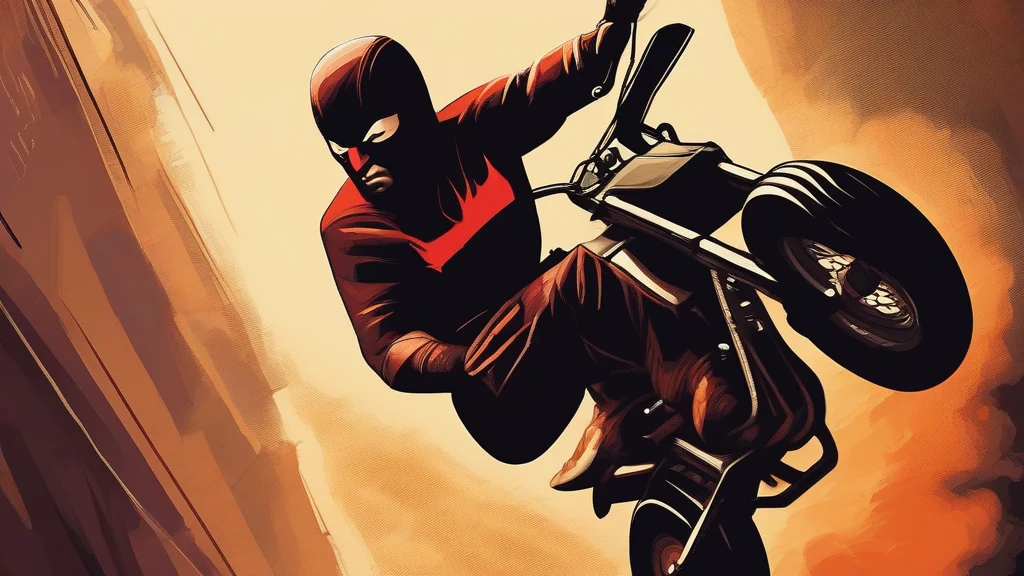
What does daredevilry mean?
Daredevilry refers to bold, risky, often spectacular behaviour — the kind of reckless daring associated with stunt performers, extreme athletes, and anyone who courts danger for thrills or applause. The word is built from 'daredevil', a term for a recklessly adventurous person, combined with the suffix '-ry', which turns it into a mass noun describing the activity or quality itself rather than the individual. It is most at home in informal or journalistic writing: reports of aerial displays, motorcycle jumps, mountaineering exploits, and other feats of nerve. Its connotation is usually admiring or playful, suggesting courage and showmanship, though it can shade into criticism when the behaviour seems merely foolhardy. Because it is uncountable, speakers speak of acts of daredevilry rather than counting individual instances. The word captures something vivid about human nature — our fascination with people who seem to treat danger as a stage.
nounBold, reckless behaviour; the practice of performing dangerous stunts or taking extreme risks, typically for excitement or display.
- Reckless, daring behaviour or the performance of dangerous stunts, especially when done for spectacle or thrill.
"The cliff divers' daredevilry drew gasps from the crowd gathered below."
"The trapeze artist's daredevilry thrilled audiences across Europe."
"His youthful daredevilry on borrowed motorbikes gave his mother years of anxiety."
Daredevilry is an uncountable (mass) noun and has no standard plural form; quantity is expressed through phrases such as 'acts of daredevilry'.
"Her career was marked by countless acts of daredevilry."
Daredevilry is one of those rare English words that smuggles a whole personality — part hero, part lunatic — into four syllables.
Reviewed by Deb Chak, Editor. AI-assisted content curated by RJS Tech Solutions LLP.
Etymology of daredevilry
Daredevilry derives from 'daredevil', a compound of the verb 'dare' (from Old English 'durran') and 'devil', first recorded in English around the late 18th century as a name for recklessly bold individuals. The suffix '-ry' — used to form nouns denoting activities or qualities, as in 'devilry' and 'buffoonery' — was added later to describe the conduct itself. It shares its second element with 'devilry' and 'devilish', both from the same root via Old English 'dēofol'.
How daredevilry is actually used
The word is informal to neutral in register and usually carries an admiring or amused connotation, though it can imply foolish recklessness depending on context. It is an uncountable noun and takes no plural in ordinary use.
Easily confused with daredevilry
Devilry means wicked or mischievous behaviour, while daredevilry means reckless, daring feats without any implication of evil.