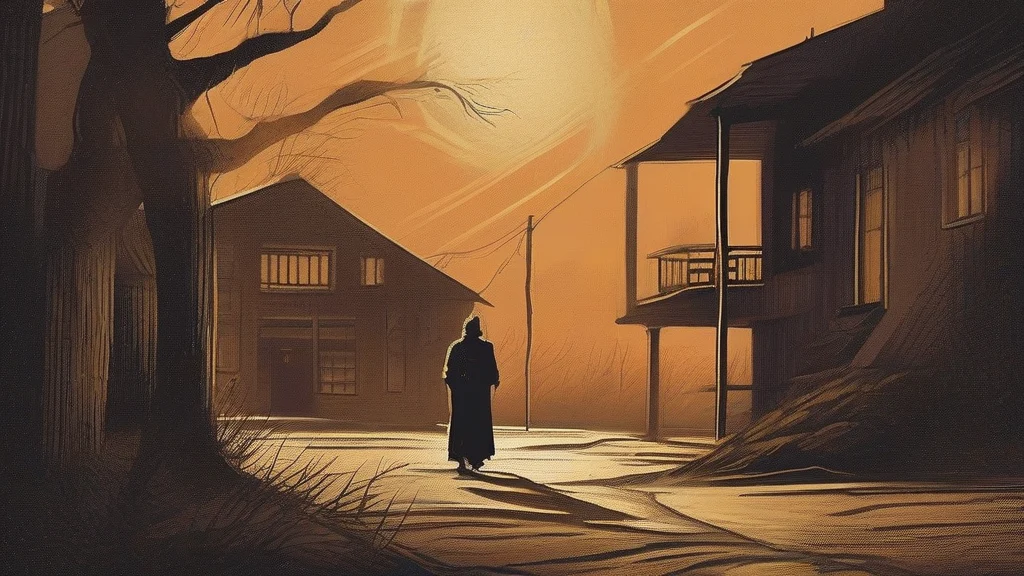
What does darking mean?
Darking is an archaic form meaning 'growing dark' or 'becoming darker'. It arises from treating the adjective 'dark' directly as a verb, with '-ing' marking it as a participle — so a phrase like 'the night was darking' once conveyed what we would now express as 'the night was darkening'. The form belongs chiefly to earlier stages of English and survives today almost exclusively in poetry, historical fiction, and quotations from older literature. Because it is no longer part of everyday vocabulary, encountering 'darking' signals either a deliberately archaic style or a text from a period when English allowed adjectives to function more freely as verbs. Its modern equivalent is 'darkening', which carries the same sense of fading light, deepening shadow, or approaching gloom. Readers who meet the word can safely interpret it as describing something in the process of becoming dark, whether literally — a sky, a room, a landscape — or figuratively, as when circumstances grow more ominous.
verb (archaic present participle)An archaic or poetic present participle of the verb 'dark', meaning growing dark or becoming darker, as in evening falling or light fading.
- Growing dark; becoming darker, especially of the sky or light at evening (archaic or literary).
"The sky was already darking as the travellers pressed on toward the village."
"It was darking fast by the time they reached the edge of the moor."
"In the old poem, the heavens begin darking as the hero makes his final stand."
Before English settled on 'darkening', poets could simply say the day was 'darking' — turning an adjective into a verb in a way modern English has all but abandoned.
Reviewed by Deb Chak, Editor. AI-assisted content curated by RJS Tech Solutions LLP.
Etymology of darking
Darking derives from the adjective 'dark', from Old English 'deorc', meaning without light or obscure. In earlier English, adjectives were sometimes used directly as verbs, allowing forms like 'it darks' or 'it was darking'; this verbal use is now obsolete, and 'darken' — formed with the causative suffix '-en' — replaced it as the standard verb. Cognate forms appear across the Germanic languages, reflecting the same Old English and Proto-Germanic root that also gave rise to 'darkness' and related words.
Related word forms
How darking is actually used
'Darking' is obsolete or highly archaic in ordinary usage; readers will encounter it mainly in older poetry and literature. Modern writers use 'darkening' instead. It should not be treated as a standard current form of English.
Easily confused with darking
'Darkening' is the standard modern present participle of 'to darken', while 'darking' is a rare, archaic form using 'dark' directly as a verb.