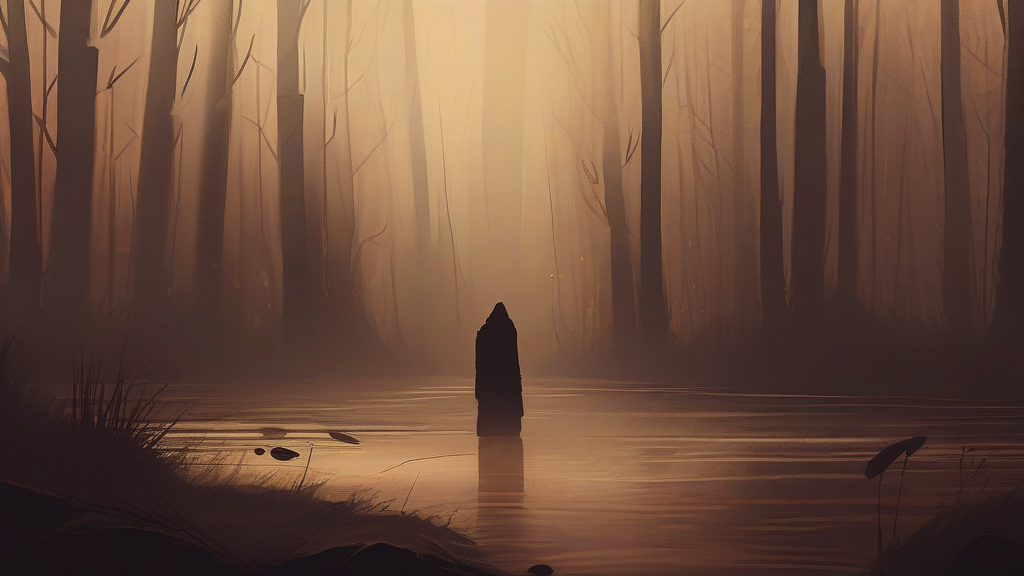
What does darkle mean?
"Darkle" is a rare literary verb meaning to grow dark, gloomy, or shadowy, or to stand out as a dark shape against a lighter ground. Where its common cousin "darken" describes the simple process of losing light, "darkle" emphasizes appearance: hills, trees, or towers may be said to darkle on the horizon as evening falls or storm clouds gather. The word derives from "dark" plus the frequentative suffix "-le," which suggests a continuing or repeated state, and it survives today almost exclusively in poetry and elevated descriptive prose. Its best-known derivative is the adverb and adjective "darkling" — meaning "in the dark" — famously used by poets such as John Keats and Matthew Arnold. Writers reach for "darkle" when they want an atmospheric, slightly archaic flavor: it lends a scene mystery and stillness, evoking silhouettes, dusk, and brooding skies rather than mere absence of light.
verbTo grow dark, gloomy, or shadowy; to appear dark or indistinct against a lighter background.
- To become dark or gloomy, especially of sky, weather, or landscape.
- To show up indistinctly or loom as a dark shape against a lighter background.
"The pines darkled against the fading evening sky."
"The moorland darkled under a lid of storm cloud."
"In the painting, distant towers darkle against a pale gold horizon."
"Darkle" gave English the haunting adverb "darkling" — the very word Keats used when he stood "on a hill at dusk" and heard nightingales sing in the gathering gloom.
Reviewed by Deb Chak, Editor. AI-assisted content curated by RJS Tech Solutions LLP.
Etymology of darkle
"Darkle" was formed in English by adding the frequentative suffix "-le" to the adjective "dark," which descends from Old English "deorc." It appeared in the language around the early 17th century. Its most enduring offspring is "darkling," originally a now-obsolete form of the present participle used adverbially to mean "in the dark," which became a favorite of Romantic and Victorian poets.
Related word forms
How darkle is actually used
"Darkle" is literary and rare, found chiefly in poetry and descriptive prose rather than everyday speech. It carries an evocative, atmospheric connotation and is most natural when describing landscapes or objects seen in failing light.
Easily confused with darkle
"Darkle" means to appear dark or loom darkly, often against light, while "darken" simply means to make or become dark.
"Sparkle" means to shine brightly with flashes of light — the opposite visual effect of the shadows implied by "darkle," despite the similar sound.