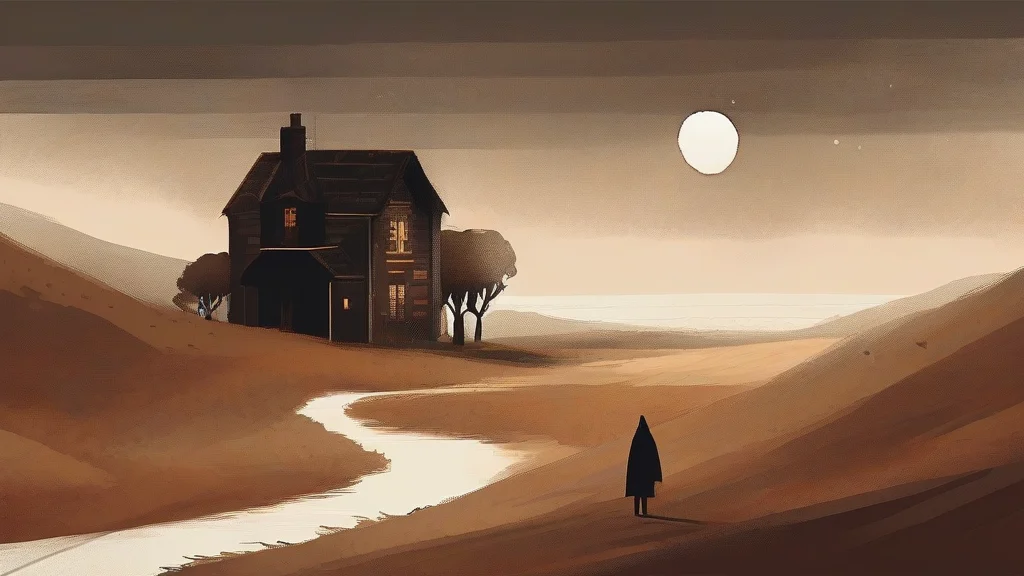
What does darkling mean?
Darkling is an evocative English word with two distinct lives. In its older, literary sense it functions as an adjective or adverb meaning 'in the dark' — describing action or existence carried out amid darkness, often with a wistful or mysterious tone. Its most celebrated appearance is in John Keats's 'Ode to a Nightingale' (1819), where he listens to the bird singing 'darkling', giving the word lasting poetic cachet. In modern scientific usage, 'darkling' is also a noun naming any beetle of the family Tenebrionidae, a large and widespread group that includes the mealworm beetle. Though rare in everyday speech, the word rewards those who know it: it condenses atmosphere into a single syllable-rich term and links romantic poetry with entomology. It should not be confused with 'darling', which merely resembles it in sound.
In the dark; occurring, done, or situated in darkness.
"She wandered darkling along the unlit lane."
Chiefly poetic; rarely heard in ordinary conversation today.
A beetle of the family Tenebrionidae; a darkling beetle.
"The mealworm in the terrarium will grow into a darkling beetle."
In the noun sense referring to beetles, plural usage typically takes the form 'darkling beetles'; the bare plural 'darklings' is less common.
"Several darkling beetles scurried beneath the bark."
Keats used 'darkling' in his famous 'Ode to a Nightingale' — and it also names an entire family of beetles.
Reviewed by Deb Chak, Editor. AI-assisted content curated by RJS Tech Solutions LLP.
Etymology of darkling
The adjectival/adverbial sense of 'darkling' was formed in early modern English from 'dark' combined with the suffix '-ling', which here conveys condition or manner ('in the manner of the dark'), on the model of words like 'groveling'. It became established through seventeenth-century poetry and was immortalized by Keats in the nineteenth century. Separately, the noun sense arose in entomology, where 'darkling beetle' designates members of the family Tenebrionidae. The root word 'dark' traces back to Old English 'deorc', making 'darkling' part of the native Germanic stock of English rather than a Latin or Greek borrowing.
How darkling is actually used
Primarily literary and somewhat archaic in its adverbial/adjectival sense; best known from Keats. The entomological sense is standard scientific usage.
Easily confused with darkling
'Darling' is a term of endearment for a beloved person, while 'darkling' means in or of the dark; they sound similar but share no meaning.
A starling is a songbird of the family Sturnidae, whereas 'darkling' as a noun denotes a beetle of the family Tenebrionidae.