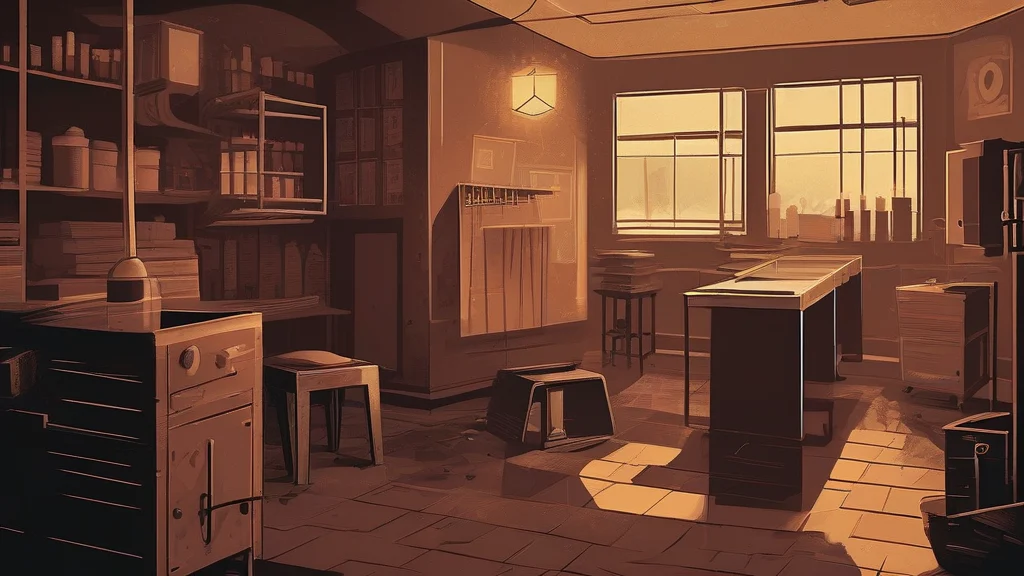
What does darkroom mean?
A darkroom is a room from which ordinary light is excluded so that light-sensitive photographic materials can be handled safely. In traditional film photography, exposed film must be developed and prints made under controlled conditions; because most films and papers are ruined by daylight, photographers work in total darkness or under safelights that emit colors to which the materials are insensitive, typically deep red or amber. A standard darkroom contains enlargers for projecting negatives onto paper, trays of developer, stop bath, and fixer, and running water for washing prints. Though digital photography has made darkrooms far less common, they remain central to fine-art and analog photography, and the word endures as shorthand for hands-on, craft-based image making. Figuratively, 'a darkroom' can evoke secrecy or hidden activity.
nounA darkened room used for processing photographic film and making prints, fitted with safelights and chemical baths so light-sensitive materials can be handled without exposure.
- A darkened, specially equipped room for developing photographic film and making prints.
- By extension, any dimly lit room kept dark (e.g., for sleeping, viewing slides, or other light-sensitive work).
"She spent hours in the darkroom, coaxing her first prints to life in the developing tray."
"He converted the spare closet into a makeshift darkroom so he could develop his own black-and-white film."
"The hospital kept a darkroom where radiographs could be processed on site."
Standard plural; used when referring to multiple facilities, e.g., across schools, newspapers, or studios.
"Both universities installed new darkrooms when they expanded their photography programs."
The darkroom's red glow isn't just atmospheric — photographic paper is nearly blind to red light, which is why printers could work for hours under it without ruining their prints.
Reviewed by Deb Chak, Editor. AI-assisted content curated by RJS Tech Solutions LLP.
Etymology of darkroom
Darkroom is a straightforward English compound of the native words 'dark' — from Old English 'deorc', of Germanic origin — and 'room', from Old English 'rūm'. The compound arose naturally once photography created a need for light-free working spaces in the mid-19th century. Its components are thoroughly Germanic rather than Latin-derived, so its closest relatives are other compounds built on 'dark' and 'room' rather than classical cognates.
Related word forms
How darkroom is actually used
Darkroom is an everyday word with neutral connotations, though it carries nostalgic associations with analog photography. It is occasionally used figuratively to suggest secrecy or things hidden from view ('shrouded like a darkroom'), but this is informal and rare.
Easily confused with darkroom
Any darkened room is simply a room with little light, whereas a darkroom specifically refers to a space equipped for processing photographic film and prints.