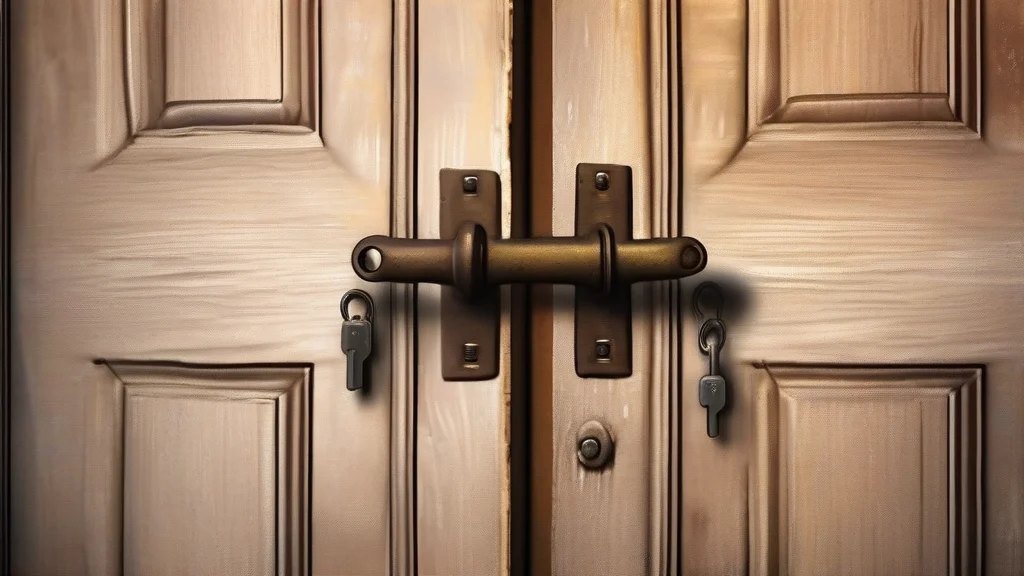
What does deadbolt mean?
A deadbolt is a type of door lock distinguished by its lack of a spring. Where an ordinary spring latch can be pressed back with a slim tool — or famously, a plastic card — slipped between the door and its frame, a deadbolt's solid metal bar stays rigidly extended until it is deliberately retracted with a key from outside or a thumb-turn from inside. This makes it the standard recommendation of security professionals for exterior doors, since it dramatically raises the effort required to force entry. Deadbolts come in single- and double-cylinder varieties, the latter requiring a key on both sides. The word is used both as a noun for the lock itself and informally as a verb meaning to engage one ('deadbolt the door'). Its name captures its defining trait: the 'dead' refers to the absence of any spring action, so the bolt is either fully out or fully in — never halfway, and never easily persuaded otherwise.
A springless door lock whose solid bolt is extended into the frame by a key or thumb-turn, providing strong resistance to forced entry.
"The landlord installed a new deadbolt on every apartment door after the break-in."
Commonly paired with 'throw', 'turn', or 'engage' when describing operating the lock.
To fasten or secure a door using its deadbolt.
"She deadbolted the front door and switched off the lights."
Informal but widely understood; typically implies locking a door at night or when leaving.
Standard plural; used mainly when discussing multiple doors or installations.
"All three exterior doors have new deadbolts."
The 'dead' in deadbolt means exactly what it sounds like — there's no spring in the mechanism, so it can't be nudged back by a credit card slipped into the doorjamb.
Reviewed by Deb Chak, Editor. AI-assisted content curated by RJS Tech Solutions LLP.
Etymology of deadbolt
The word combines 'dead', here meaning motionless or lacking spring action, with 'bolt', the Old English term (from Proto-Germanic *bultaz) for a sliding metal bar used to fasten a door. The compound arose as lock technology matured, distinguishing springless security bolts from ordinary spring latches. Cognate forms of 'bolt' appear throughout the Germanic languages, giving us related words such as 'thunderbolt'. The term became widespread in English during the 19th and 20th centuries as mass-produced mortise and rim locks made deadbolts a household fixture.
How deadbolt is actually used
Primarily a practical, everyday word associated with home security and locksmithing; neutral register. As a verb it is usually transitive in form ('deadbolt the door') though often used without stating an object.
Easily confused with deadbolt
A latch uses a spring-loaded bolt that can be pushed back easily (often with a credit card), whereas a deadbolt has no spring and must be deliberately retracted with a key or thumb turn.