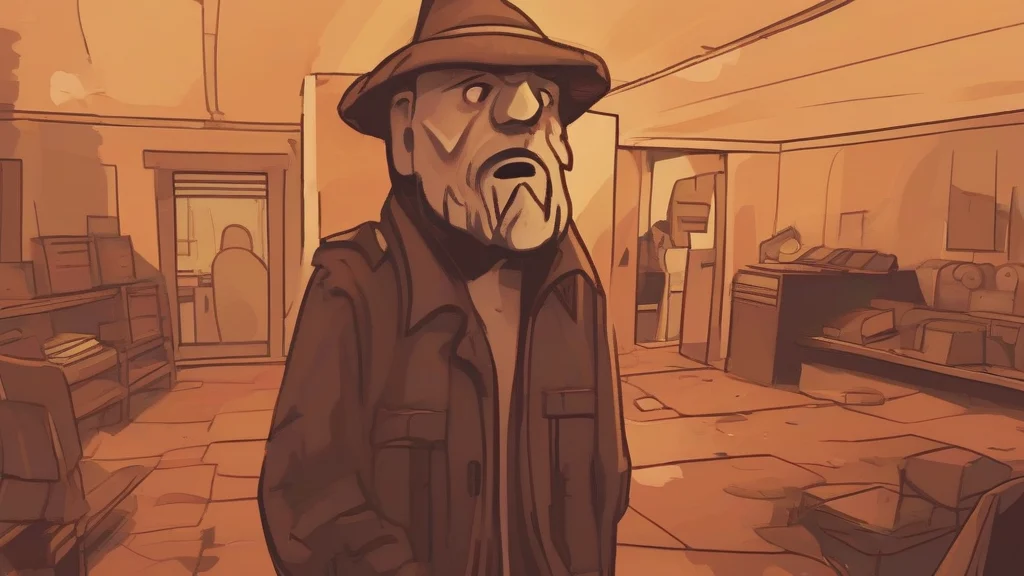
What does deadpan mean?
Deadpan describes a deliberate absence of expression or emotion in one's face, voice, or delivery — most often employed as a comic technique. A person speaking deadpan delivers jokes, absurdities, or startling statements in a perfectly flat, matter-of-fact tone without smiling, raising an eyebrow, or signalling that anything unusual is happening. The word functions as an adjective ('a deadpan remark'), an adverb ('she replied deadpan'), and less commonly a noun ('his trademark deadpan'). Its power lies in contrast: the greater the gap between what is said and how calmly it is delivered, the funnier or more striking the effect. Deadpan humor is associated with comedians and comedic styles ranging from classic silent-era performers to modern sitcom characters, and it remains a staple of both British and American comedy. The term derives from early twentieth-century American slang, in which "pan" was a word for the face; a "dead pan" was thus a face devoid of animation. Related forms include the verbs deadpanned and deadpanning.
Showing no emotion, expression, or reaction, typically in order to create a humorous or striking contrast with what is being said or done.
"The comedian's deadpan delivery made even mundane observations hilarious."
Most frequently used before nouns such as 'delivery', 'humor', 'voice', or 'expression'.
In an expressionless, matter-of-fact manner, especially when saying something funny, absurd, or surprising.
""I've decided to move to Mars," he said, entirely deadpan."
A completely expressionless face, voice, or overall manner of delivery; the style itself.
"Her perfect deadpan fooled everyone at the meeting."
Less common than the adjectival use, but well established in writing about comedy and performance.
Rarely used in the plural. When pluralized, it typically refers to multiple instances of the expressionless style or manner, e.g., in discussing different comedians' deadpans.
"The two actors' deadpans complemented each other perfectly throughout the sketch."
"Deadpan" literally means a "dead pan" — an old American slang term for a completely blank, lifeless face.
Reviewed by Deb Chak, Editor. AI-assisted content curated by RJS Tech Solutions LLP.
Etymology of deadpan
Deadpan originated as American slang in the early twentieth century. In contemporary slang, "pan" was a common informal word for the face, so a "dead pan" literally meant a face that showed no signs of life or animation. The compound quickly moved from describing a blank facial expression to describing the broader style of flat, unemotional delivery, particularly in comedy and performance. From there it developed into an adjective, then an adverb, and eventually a noun referring to the style itself.
Related word forms
How deadpan is actually used
Deadpan is informal to neutral in register and appears frequently in discussions of comedy, acting, and everyday speech. It carries a connotation of controlled restraint rather than coldness — the lack of expression is usually intentional and often deployed for comedic timing. It is common in both British and American English. The verb form 'to deadpan' is well attested but slightly less frequent than the adjective.
Easily confused with deadpan
A deadlock is a stalemate where no progress is possible, whereas deadpan describes an expressionless manner or face.
Poker face refers specifically to a blank expression that hides one's feelings or intentions, while deadpan more broadly describes a flat, unchanging delivery often used for comic effect.