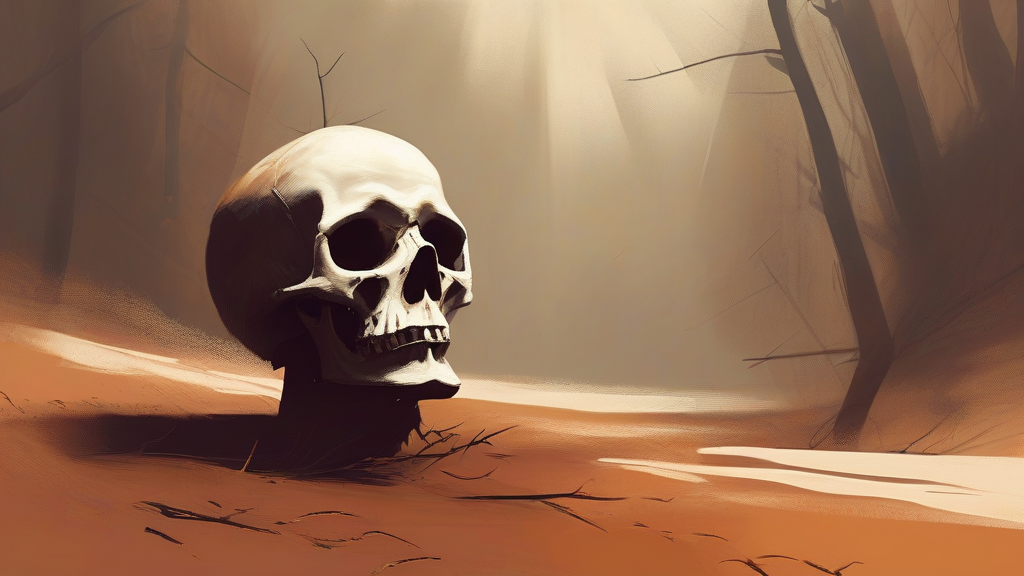
What does death mean?
Death is the noun denoting the permanent end of life — the moment or state at which a living organism ceases to live. It is one of the most universal words in any language, appearing in medical, legal, religious, and everyday contexts alike: we speak of a cause of death, a death certificate, or the death of a loved one. Beyond its literal sense, death is frequently used figuratively to mark the end of anything, as in 'the death of an industry' or 'a matter of life and death'. Though neutral in tone, the word carries unavoidable gravity, which is why speakers often reach for gentler alternatives such as 'passing' or 'loss' in conversation. Derived forms like 'deathly', 'deathbed', and 'deathless' extend its reach into adjective and compound usage. Few English words are as fundamental, as old, or as culturally weighty as this one.
The permanent end of life in a person, animal, or other living organism; the state of being dead.
"The coroner recorded a verdict of natural death."
Countable when referring to individual deaths ('three deaths were reported'); uncountable when referring to the general state or concept ('fear of death').
Figuratively, the end or destruction of something, such as a practice, hope, or institution.
"Streaming services rang the death knell for the video rental store."
Used when counting individual instances of dying, especially in reports and statistics; the uncountable singular refers to the concept itself.
"The storm was responsible for several deaths along the coast."
Old English once had a whole vocabulary for death that modern English has quietly buried — 'death' itself descends from a Germanic root shared with the verb 'to die'.
Reviewed by Deb Chak, Editor. AI-assisted content curated by RJS Tech Solutions LLP.
Etymology of death
Death comes from Old English 'dēath', formed from a Germanic root related to the verb 'to die' and the adjective 'dead'. It shares this Germanic ancestry with cognates such as Old Norse 'dauthr' and Old High German 'tōd'. The word has remained remarkably stable in form and meaning throughout the history of English, making it one of the language's oldest continuously used terms.
Related word forms
How death is actually used
Neutral in register but inherently solemn; euphemisms such as 'passing' or 'loss' are often preferred in sensitive social contexts. In figurative use ('the death of an idea'), the word takes on a more literary or dramatic tone.
Easily confused with death
A 'dearth' is a scarcity or shortage of something, while 'death' is the end of life — the words look and sound similar but are unrelated.