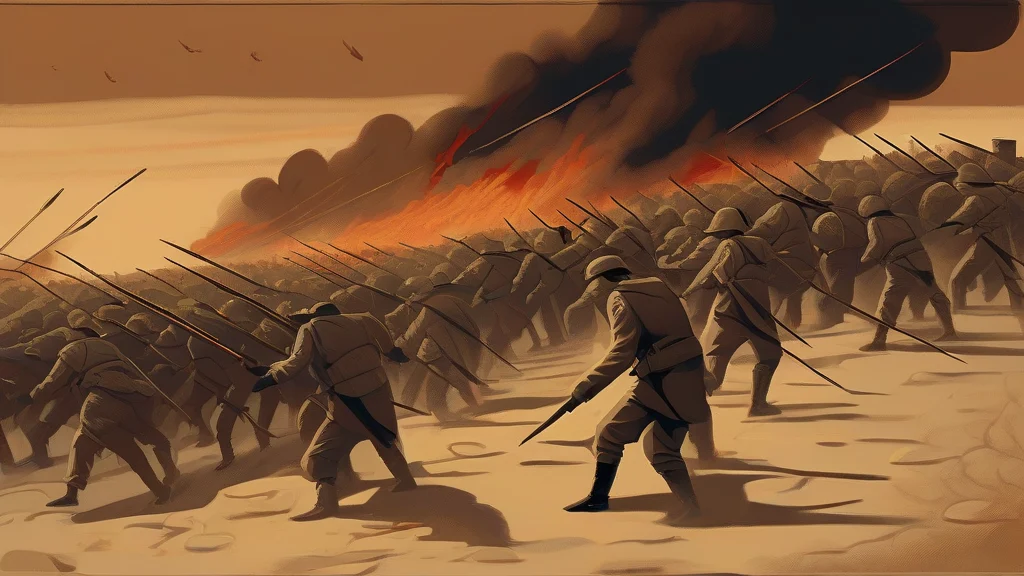
What does decimating mean?
"Decimating" is the present participle of the verb "decimate," meaning to kill, destroy, or remove a large proportion of a group, population, or resource. It is most commonly used in journalism and formal writing to describe severe damage inflicted on communities, wildlife, economies, or armies — for instance, a disease decimating livestock herds or a recession decimating an industry's workforce. The word's history is striking: it derives from Latin decimare, from decimus, meaning "tenth." In ancient Rome, decimatio was a brutal military punishment in which a mutinous unit had one soldier in ten selected by lot and executed by his comrades. Because of this origin, some traditionalists insist that "decimate" should mean only "reduce by one-tenth," but modern usage overwhelmingly favors the broader sense of devastating destruction, and major dictionaries accept both meanings. The word always connotes heavy, often catastrophic loss, making it more forceful than words like "reduce" or "diminish" and best suited to contexts of genuine devastation.
Present participle of decimate: killing, destroying, or drastically reducing the numbers of a group or population.
"Poaching gangs were decimating elephant herds faster than conservationists could respond."
Often used with natural disasters, disease, war, or economic forces as the subject.
The act or process of destroying a large proportion of something; the ongoing devastation of a group or population.
"The decimating of the coral reefs alarmed marine biologists worldwide."
As a gerund it is less common than the noun "decimation," which is preferred in formal writing.
The word comes from Roman military discipline: if a legion mutinied, one soldier in ten was executed by lot — that was 'to decimate.'
Reviewed by Deb Chak, Editor. AI-assisted content curated by RJS Tech Solutions LLP.
Etymology of decimating
"Decimating" traces back to Latin decimare, meaning "to take a tenth," formed from decimus ("tenth") and ultimately from decem ("ten"). In Roman practice, decimatio punished mutinous legions by executing one soldier in ten, chosen by lot — the sense carried into English when the verb "decimate" was adopted in the early seventeenth century. Over time the word broadened to mean destroying any substantial proportion of a group, a shift that traditionalists have long contested but that dictionaries now record as fully established. Cognates sharing the same Latin root include "decimal," "decile," and "decimation."
Related word forms
How decimating is actually used
"Decimate" is frequently used loosely to mean "destroy completely," which purists object to since the etymology implies reducing by roughly one-tenth; standard dictionaries now accept the broader sense. The word carries strong negative connotations of large-scale loss.
Easily confused with decimating
To disseminate is to spread or distribute information widely, whereas to decimate is to destroy or drastically reduce something.