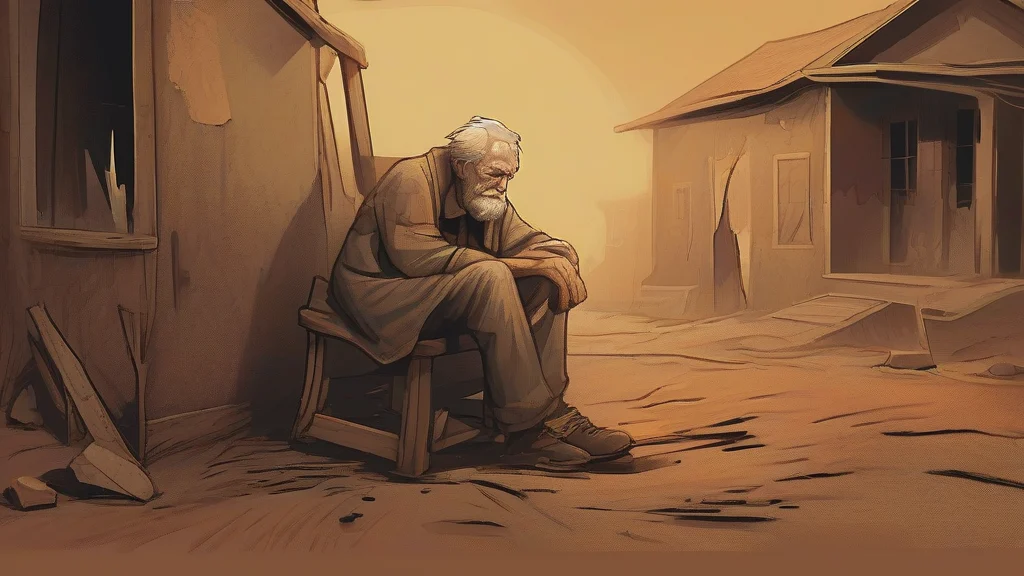
What does decrepitude mean?
Decrepitude is a formal noun describing the state of being worn out — whether by old age, overuse, or neglect. Applied to people, it refers to profound physical frailty and decline: a body weakened past ordinary aging into helplessness. Applied to buildings, vehicles, institutions, or infrastructure, it conveys advanced disrepair, the kind of ruin that comes from years of decay left unattended. The word carries an unmistakably negative tone, evoking not just deterioration but a sense of sad inevitability, and its Latinate formality suits serious writing more than everyday speech. It derives from the Latin decrepitus, meaning worn out by age, itself rooted in a verb suggesting a crackling or creaking sound — the audible sign of something giving way. Writers reach for decrepitude when they want to convey collapse that is thorough and probably permanent, whether describing an aged relative's failing strength or a once-grand theater reduced to peeling paint and rubble. It remains uncountable in modern English.
nounThe state of being worn out or ruined by old age, long use, or neglect; extreme physical weakness and dilapidation.
- A state of extreme physical weakness or infirmity caused by advanced old age.
- A state of severe disrepair or deterioration affecting buildings, objects, institutions, or systems.
"After decades of harsh winters, the barn had sunk into a state of sad decrepitude."
"In his final years, despite his mental sharpness, he struggled against the physical decrepitude that confined him to a chair."
"Critics warned that the city's bridges were sliding into dangerous decrepitude after years of deferred maintenance."
Rarely pluralized; decrepitude functions almost exclusively as an uncountable noun, though a rare plural may appear in literary contexts referring to multiple distinct instances of decay.
"The travel writer catalogued the decrepitudes of the empire's abandoned outposts."
Decrepitude comes from a Latin root meaning 'to crack with age' — the same family of sounds you hear in 'crepitate' and even 'crepuscular', words all born from things breaking down or growing dim.
Reviewed by Deb Chak, Editor. AI-assisted content curated by RJS Tech Solutions LLP.
Etymology of decrepitude
Decrepitude entered English in the early 17th century, borrowed from French décrépitude and ultimately from Latin decrepitus, meaning 'worn out by age'. The Latin term likely derives from de- ('down, away') combined with crepare ('to crack, creak'), so the original image was of something literally cracking under the strain of time. The adjective decrepit came into English earlier, in the 15th century, from the same Latin source, making the noun a later companion to an established word for age-worn frailty.
Related word forms
How decrepitude is actually used
Decrepitude is a formal, literary word carrying a strongly negative connotation of irreversible decline. When applied to people it emphasizes bodily frailty rather than mere age, and when applied to buildings or systems it suggests neglect has hastened the ruin. It is uncountable in standard usage and rarely appears in casual conversation.
Easily confused with decrepitude
Decrepitude is a state of worn-out decay, while decrepitation is the technical process of cracking apart when heated, as certain minerals do.