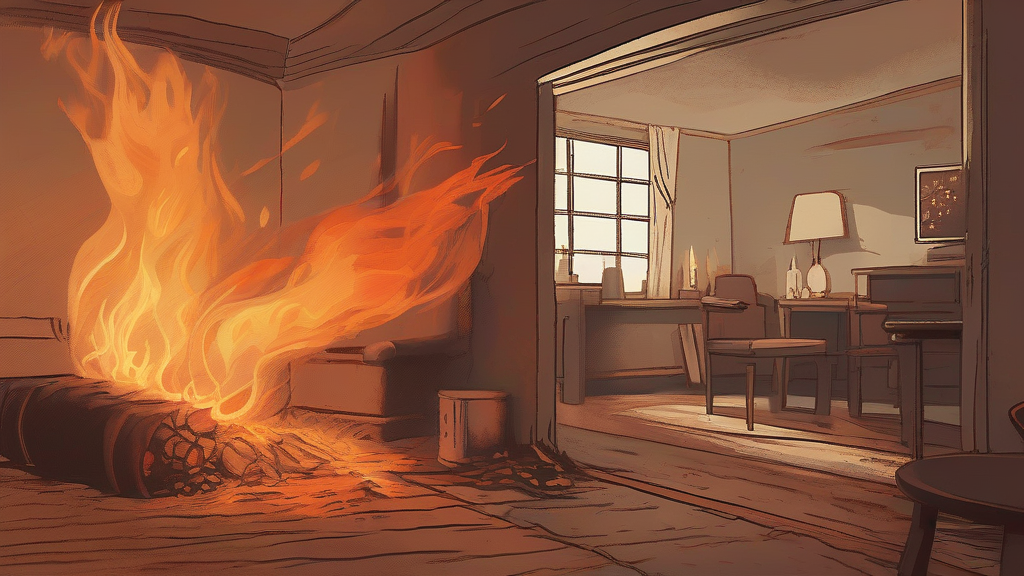
What does deflagrated mean?
"Deflagrated" is the past tense of "deflagrate", a technical verb meaning to burn away rapidly and intensely with a bright flame. In chemistry and pyrotechnics, deflagration describes combustion that propagates through a material at subsonic speed — fast enough to consume a substance in what looks like a flash, but slower than the supersonic shockwave of a true detonation. Gunpowder, for instance, deflagrates; high explosives detonate. The word derives from Latin "deflagrare", meaning "to burn down" or "consume by fire", from "flagrare", "to blaze" — the same root behind "conflagration" and "flagrant". Because of its precise scientific meaning, "deflagrated" appears almost exclusively in laboratory reports, safety literature, and discussions of energetic materials, lending any sentence a formal, exacting tone. For readers interested in how things burn, it marks a genuinely useful distinction between mere ignition and violent, self-consuming combustion.
verbPast tense and past participle of "deflagrate": to burn rapidly and intensely with a bright flame, as when a substance combusts almost instantaneously rather than smouldering.
- (of a substance) to burn rapidly and intensely with a bright flame, undergoing swift combustion
- (in chemistry) to react with oxygen so quickly that the material is consumed in a flash of light and heat
"The magnesium powder deflagrated with a blinding white flash the moment it touched the flame."
"The sulfur deflagrated the moment the hot rod touched it, filling the fume hood with acrid smoke."
"Chemists distinguish between materials that merely ignite and those that deflagrate, consuming themselves in a single brilliant burst."
When gunpowder burns, it doesn't explode — it deflagrates: a fire so fast it races through the material faster than you can blink, yet slower than sound.
Reviewed by Deb Chak, Editor. AI-assisted content curated by RJS Tech Solutions LLP.
Etymology of deflagrated
"Deflagrated" traces to Latin "deflagrare", meaning "to burn down or consume by fire", formed from "de-" (down, away) plus "flagrare" (to blaze), from the root of "flamma" (flame). The word entered English in the early modern period, around the 17th century, largely in alchemical and later chemical writing. It shares its fiery root with "conflagration", "flagrant", "flamboyant", and "flammable".
Related word forms
How deflagrated is actually used
Deflagrated belongs chiefly to technical registers — chemistry, pyrotechnics, and fire science — where it carries a precise meaning distinct from ordinary burning or explosion. It sounds formal and clinical; in everyday speech most speakers would simply say "burst into flames".
Easily confused with deflagrated
"Detonated" refers to an explosive supersonic reaction producing a shockwave, whereas "deflagrated" describes rapid combustion that propagates at subsonic speed without detonation.
"Conflagrated" is a rare verb relating to a large destructive fire spreading over an area, while "deflagrated" describes a substance burning away rapidly in a single intense flash.