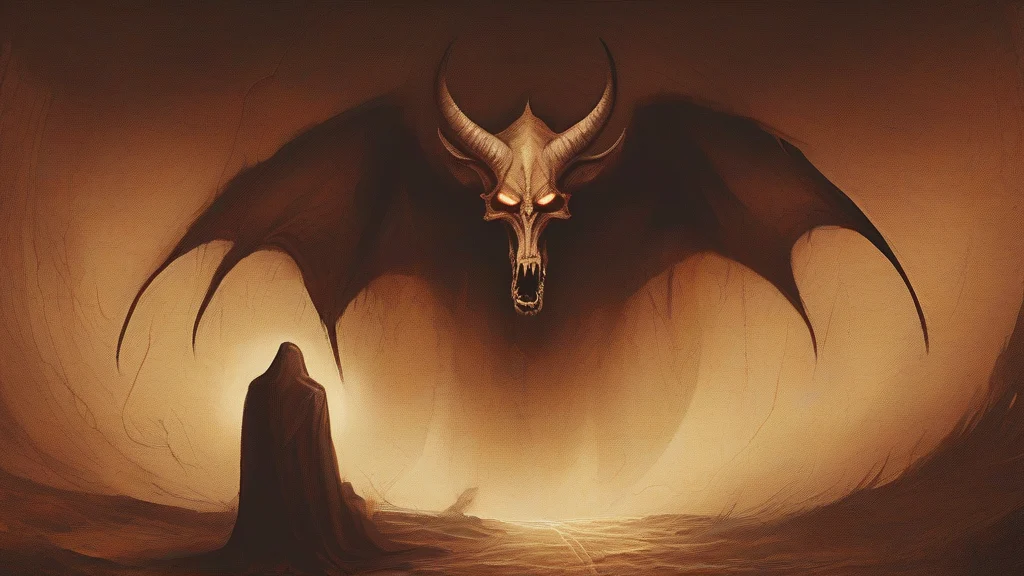
What does demonism mean?
Demonism is a noun denoting belief in demons — their existence, their power to influence human affairs, and, in some contexts, their worship. The term appears most often in scholarly writing on comparative religion, anthropology, folklore, and literary criticism, where it describes systems of thought that attribute misfortune, illness, or moral corruption to demonic agency. It can refer broadly to such beliefs within a culture or more narrowly to actual veneration of demons, overlapping with but distinct from demonology (the systematic study of demons) and satanism (devotion centered specifically on Satan). Historically, the word gained currency in descriptions of medieval Christianity and of non-European religious traditions, sometimes with a judgmental edge that modern scholarship avoids. Though uncommon in casual speech, demonism remains useful for precisely naming the conviction that unseen evil spirits actively shape the world — a conviction found across many eras and cultures.
nounThe belief in, or worship of, demons; the attribution of events or phenomena to demonic agency. It can also denote a preoccupation with demons or demonic forces, especially in religion, folklore, or literary criticism.
- Belief in the existence and activity of demons.
- Worship of or devotion to demons (demon-worship).
- A tendency to attribute events, especially misfortunes, to demonic influence; a preoccupation with demons.
"The medieval tract reflects the demonism that shaped so much of Europe's religious imagination."
"Anthropologists have documented forms of demonism across many traditional societies."
"The critic accused the novelist of trading in cheap demonism, populating every chapter with malevolent spirits."
Rarely pluralized; used only when contrasting distinct belief systems or traditions involving demons.
"Comparative religion courses examine the varied demonisms of different cultures."
Before psychology gave us names for our fears, whole centuries explained madness, storms, and misfortune through demonism — a word for when evil spirits, not chance, run the world.
Reviewed by Deb Chak, Editor. AI-assisted content curated by RJS Tech Solutions LLP.
Etymology of demonism
Demonism derives from "demon," which traces back through Latin daemon to Greek daimōn (δαίμων), originally meaning a divine or semi-divine being before acquiring its negative connotation in Jewish and Christian tradition. The suffix "-ism" marks it as a system of belief or practice. The word entered English in the early modern period, when writers used it to characterize both foreign religions and what they saw as superstitious currents within Christendom. It shares its root with related English words such as demonic, demoniac, and demonize.
How demonism is actually used
"Demonism" is a formal, largely academic or literary term; it is rare in everyday conversation. It is typically used neutrally by scholars of religion, anthropology, and history rather than pejoratively, though it can carry a dismissive tone when describing another group's beliefs.
Easily confused with demonism
Demonology is the systematic study of demons and their hierarchy, whereas demonism is belief in or worship of demons themselves.
Satanism specifically centers on Satan as an object of veneration or ideology, while demonism is a broader term for belief in or devotion to demons in general.