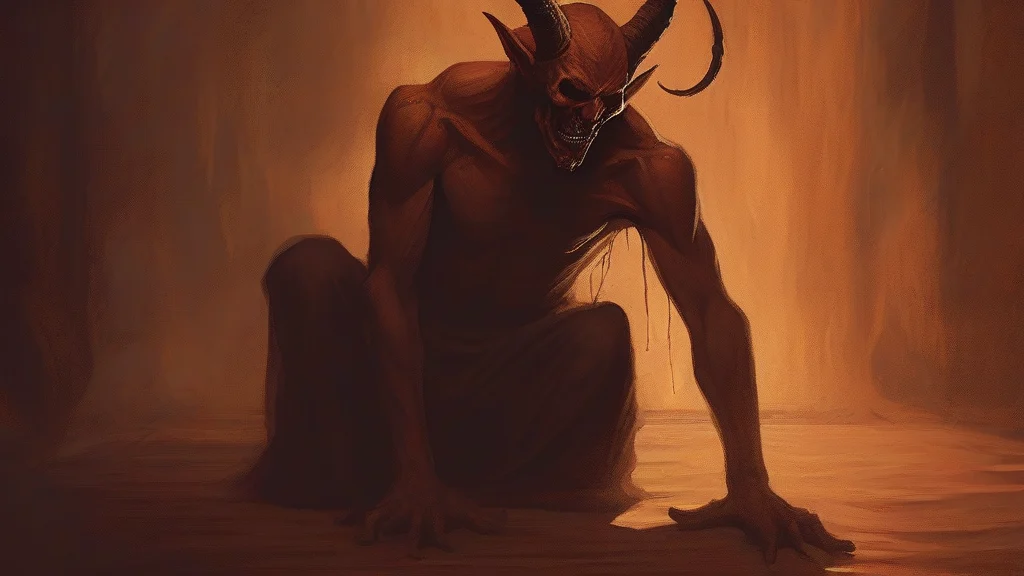
What does demoniac mean?
A demoniac is, most literally, a person believed to be possessed by an evil spirit — a figure central to religious narratives of exorcism from antiquity through the early modern period. In its adjectival form, demoniac has broadened beyond the strictly supernatural to describe anything frenzied, violent, or wildly uncontrolled: a demoniac laugh, a demoniac rage, a demoniac energy that seems barely human. The word derives ultimately from the Greek daimonion, meaning an evil spirit, entering English via ecclesiastical Latin and French during the sixteenth century. Today the noun appears mainly in historical, theological, and literary writing, while the adjective remains a vivid choice for writers seeking to convey ferocity with a hint of the uncanny. It is more formal than words like frantic or berserk, and its supernatural undertone lends it a distinctive dramatic weight.
A person believed to be possessed by a demon or evil spirit.
"The gospels record several occasions on which Jesus healed a demoniac by casting out the unclean spirit."
Primarily found in historical, biblical, and literary contexts rather than everyday speech.
Frenzied, wild, or violently uncontrolled in a manner suggestive of demonic possession; also, of or relating to demons.
"He let out a demoniac shriek as the roller coaster plunged down the first drop."
Often used hyperbolically in descriptive writing to intensify depictions of rage, laughter, or energy.
Used when referring collectively to people regarded as possessed, typically in historical or religious discussion.
"Medieval monasteries sometimes served as refuges where demoniacs were brought for prayer and exorcism."
"Demoniac" shares its Greek root with "pandemonium" — the word John Milton coined for the capital of Hell in Paradise Lost.
Reviewed by Deb Chak, Editor. AI-assisted content curated by RJS Tech Solutions LLP.
Etymology of demoniac
Demoniac comes from the Greek daimoniakos, derived from daimonion, meaning an evil spirit or lesser deity. The word entered English in the mid-sixteenth century through ecclesiastical Latin daemoniacus and French démoniaque, initially as a noun referring to the possessed. Its adjectival use, describing frenzied behavior suggestive of possession, developed alongside it. It shares its Greek root with related terms such as demonic, demonology, and pandemonium, which Milton coined in 1667 for the capital of Hell in Paradise Lost.
How demoniac is actually used
The noun sense is largely confined to historical, religious, or literary contexts describing accounts of possession. The adjective survives more actively in descriptive writing to convey wildness, frenzy, or unsettling energy. Both senses carry a strongly negative connotation and are relatively formal or literary rather than colloquial.
Easily confused with demoniac
Demonic means relating to or characteristic of demons themselves, while demoniac more often refers to a state of frenzy or possession affecting a person.
A maniac is someone wildly insane or obsessive; a demoniac is specifically someone believed to be possessed by an evil spirit, though both can describe frenzied behavior.