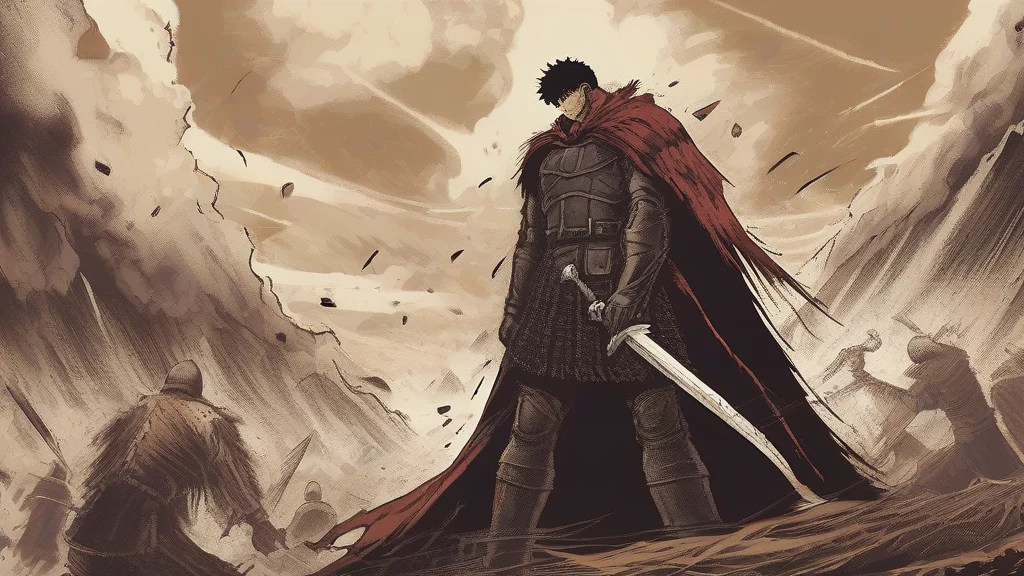
What does berserk mean?
Berserk describes a state of wild, uncontrollable fury or frenzy — someone or something acting with chaotic, often destructive energy. It functions chiefly as an adjective, as in "he went berserk when he heard the news," though it can also serve as a noun referring to such an outburst itself. The word carries strongly negative connotations of violence, irrationality, and loss of self-control, and it appears most often in informal speech and journalism rather than formal writing. Its most common construction is the idiomatic phrase "go berserk," used both for genuine rage and for ecstatic excitement, as when a crowd erupts at a concert or sporting victory. The term traces back to Old Norse berserkr, denoting legendary Viking warriors who fought in a frenzied trance, which gives the modern word a vivid historical resonance.
Out of control with violent anger or frenzy; wildly frantic.
"She went berserk when she found out her flight had been cancelled again."
Almost always appears predicatively (after a verb like 'go'), rarely attributively before a noun.
A frenzied, uncontrollable state of rage or violence.
"The player's berserk on the pitch earned him a red card."
Rare; the plural noun form is uncommon and mostly appears in reference to multiple frenzied outbursts or to the historical berserker warriors.
"The sagas describe the berserks who terrorized their enemies with uncontrolled fury."
Berserk comes straight from Old Norse — it originally described Viking warriors who fought in a trance-like fury, possibly wearing bearskins.
Reviewed by Deb Chak, Editor. AI-assisted content curated by RJS Tech Solutions LLP.
Etymology of berserk
Berserk derives from Old Norse berserkr, the name given to Viking warriors who fought in a frenzied, trance-like state. The etymology of berserkr is debated but is commonly explained as combining ber- ('bear') with serkr ('shirt'), suggesting warriors who wore bearskins into battle. The word entered English in the early 19th century through accounts of Norse history and legend. Cognates include the plural form 'berserkers', used to refer to those warriors directly.
Related word forms
How berserk is actually used
Common in informal and journalistic registers, especially in the fixed phrase "go berserk." The noun form is less frequent than the adjectival use.
Easily confused with berserk
"Beserk" is simply a common misspelling of "berserk", which is correctly spelled with an 'r' after 'be'.