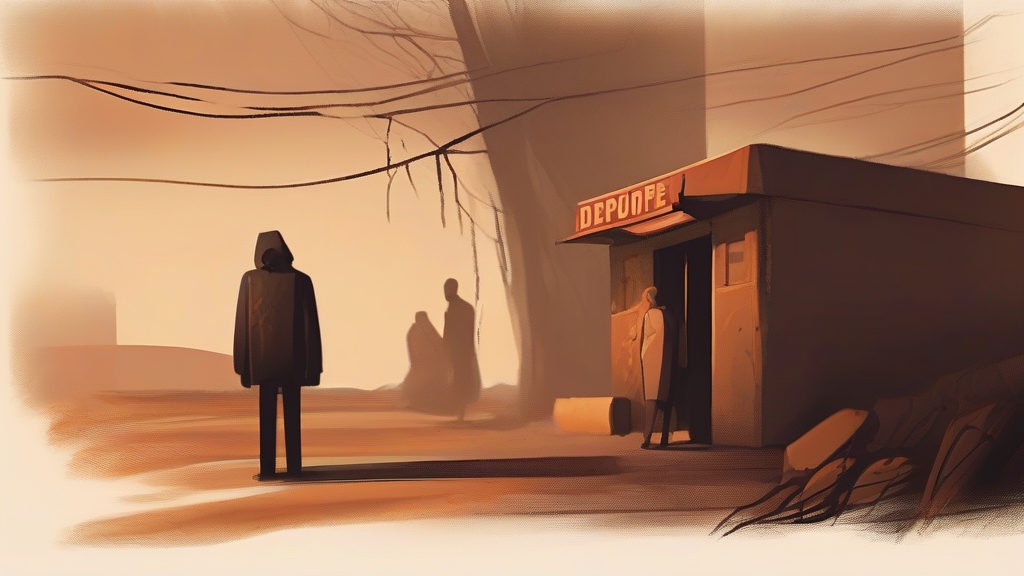
What does depeople mean?
Depeople is a rare English verb meaning to strip a place of its inhabitants — to make a land, town, or region empty of people. Formed from the prefix 'de-' (indicating removal or reversal) and 'people' (used as a verb meaning to furnish with inhabitants), it is essentially a synonym of the much more common 'depopulate'. The word carries a weighty, often sombre connotation, since places are usually depeopled by famine, war, plague, forced removal, or mass emigration rather than by choice. Because it is literary and infrequent, modern readers encounter it mainly in historical writing or deliberately elevated prose, where it can lend a passage an archaic or solemn force. Writers today would more naturally choose 'depopulate', but depeople remains a legitimate, if uncommon, alternative that makes vividly literal the idea of un-peopling a landscape.
verbTo deprive an area, place, or population of its people; to depopulate.
- To deprive a place or region of its inhabitants; to depopulate.
"The famine and subsequent emigration depopulated — indeed all but depeopled — the western islands within a generation."
"War and pestilence had depeopled entire provinces by the end of the campaign."
"The enclosure movement threatened to depeople the countryside as labourers drifted to the cities."
Before 'depopulate' took over the job, writers reaching for a word for emptying a land of its people could simply un-people it: depeople.
Reviewed by Deb Chak, Editor. AI-assisted content curated by RJS Tech Solutions LLP.
Etymology of depeople
Depeople is formed within English from the prefix 'de-', indicating removal or deprivation, combined with 'people' in its verbal sense of 'to populate or furnish with inhabitants'. The verbal use of 'people' itself derives ultimately from Latin populus, meaning 'a people or nation', via Old French peuple. Depeople arose as a straightforward English coinage on this pattern, alongside synonyms such as 'dispeople' and 'depopulate'; the latter, borrowed through French and Latin, eventually became the standard term.
How depeople is actually used
A rare and somewhat literary word, now largely displaced by the far more common 'depopulate'. It appears mostly in historical or elevated prose. It is a transitive verb taking the emptied place as its direct object.
Easily confused with depeople
Dispeople is a near-synonymous rare verb also meaning to deprive of inhabitants; the two are variants rather than different meanings.