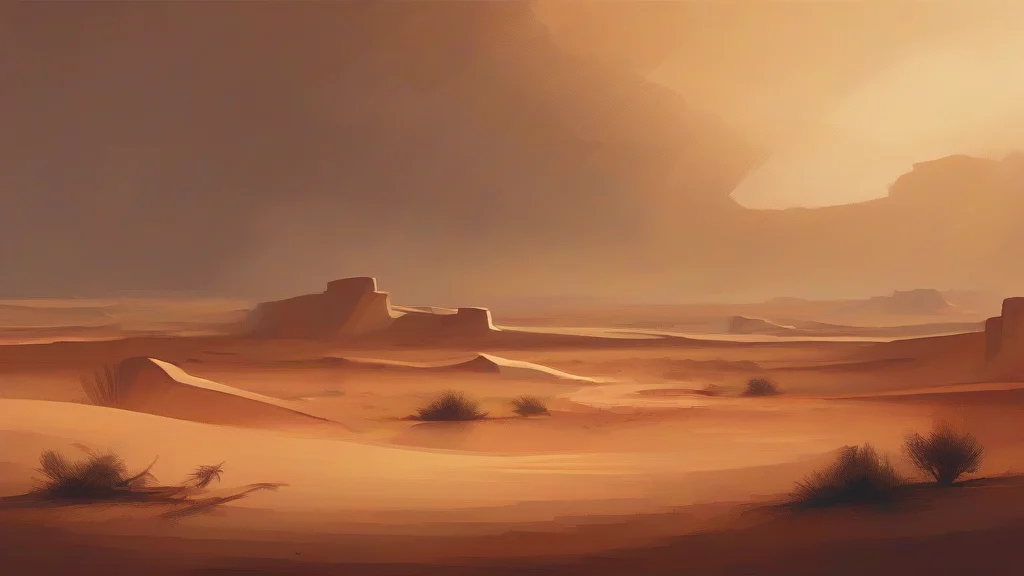
What does desertified mean?
"Desertified" describes land that has been transformed into something resembling a desert — dry, barren, and largely unable to support plant life — usually as a result of environmental degradation. The term arises most often in scientific, geographical, and policy contexts, appearing in discussions of deforestation, overgrazing, soil erosion, drought, and climate change. A sentence such as "Overgrazing has left the grasslands severely desertified" illustrates its typical use: it functions as an adjective, often modifying nouns like land, soil, or region, and derives from the verb "to desertify" alongside the noun "desertification." The word carries strongly negative connotations, implying loss of fertility and productivity, and frequently signals concern about human activity's impact on ecosystems. Though not common in casual conversation, it is a valuable term for anyone reading about environmental science or sustainability.
adjectiveConverted into or reduced to a desert, especially through environmental degradation such as deforestation, overgrazing, or climate change; made arid and unproductive.
- (Of land) converted into desert-like conditions through degradation such as deforestation, overgrazing, drought, or climate change.
"Once-fertile plains have become desertified after decades of overgrazing and drought."
"Vast swathes of the Sahel have become desertified over the past century."
"The report warned that poor irrigation practices had left large areas of farmland desertified and unusable."
It's one of the few words that literally means 'turned into a desert' — coined in the 20th century as scientists watched once-green land turn to sand.
Reviewed by Deb Chak, Editor. AI-assisted content curated by RJS Tech Solutions LLP.
Etymology of desertified
"Desertified" derives from "desertify," a verb formed in modern English by combining "desert" — which traces back through Old French to the Latin noun "desertum," meaning an abandoned or forsaken place, from the verb "deserere" (to abandon) — with the productive suffix "-fy," itself from Latin "-ficare" (to make). The verb and its derivatives arose in the 20th century, when scientists and policymakers needed precise vocabulary for the spread of desert-like conditions into previously productive land. Related forms include "desertification" for the process itself.
Related word forms
How desertified is actually used
"Desertified" is most often used as an adjective derived from the verb "desertify," and it belongs primarily to formal, scientific, and environmental discourse — geography, climatology, and policy writing — rather than everyday conversation. It carries a negative connotation of human-caused or climate-driven ecological loss. It frequently appears attributively before nouns like "land," "soil," or "regions."
Easily confused with desertified
"Desertified" describes land that has been environmentally degraded into desert-like conditions, while "deserted" means abandoned or left empty by people.
"Dessertified" is not a standard English word; "desertified" (one s in the middle) refers to land turning into a desert.