What does destroyer mean?
A destroyer is either an agent of ruin or a formidable instrument of naval power. In its broadest sense, a destroyer is any person or thing that destroys — fire may be called a destroyer of homes, time a destroyer of empires, or a tyrant a destroyer of liberties. More specifically, a destroyer is a class of fast, maneuverable warship, originally developed in the late nineteenth century to counter torpedo boats and now serving primarily as an escort for fleets, hunting submarines, and launching guided missiles. The word carries connotations of force and finality: to call someone a destroyer is rarely neutral. Its most famous cultural resonance comes from Robert Oppenheimer's recollection of the Bhagavad Gita at the first atomic bomb test — "Now I am become Death, the destroyer of worlds" — which fixed the phrase in modern consciousness. Whether applied to machines of war or forces of nature, destroyer names whatever leaves wreckage behind it.
A person or thing that destroys something.
"Locusts proved to be the destroyer of the season's entire harvest."
Often used figuratively with abstract forces such as fire, time, or war.
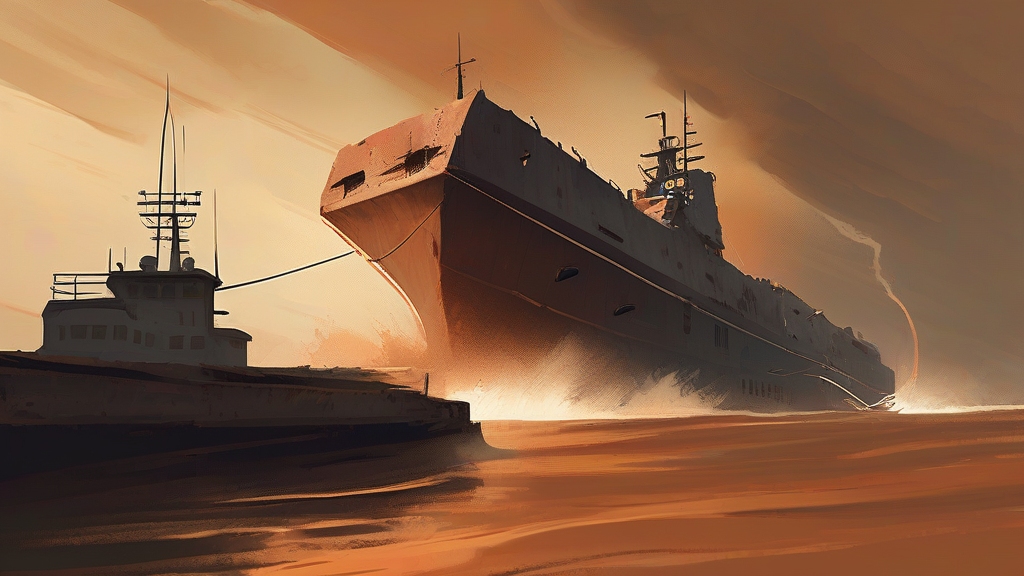
A fast, heavily armed warship smaller than a cruiser, used for escorting fleets, anti-submarine warfare, and missile attacks.
"The guided-missile destroyer anchored just off the harbor."
Always countable; commonly preceded by designations such as "escort," "fleet," or "guided-missile."
Standard plural; both the general sense and the naval sense take regular -s plurals.
"Three destroyers escorted the aircraft carrier through the channel."
The USS Zumwalt, America's most advanced destroyer, is so stealthy that in tests other ships struggled to even detect it on radar.
Reviewed by Deb Chak, Editor. AI-assisted content curated by RJS Tech Solutions LLP.
Etymology of destroyer
Destroyer derives from the verb destroy, which entered Middle English around the thirteenth century via Old French destruire, from Latin destruere, meaning "to unbuild" or "tear down" — formed from de- ("down, away") plus struere ("to build, pile up"). The agent noun destroyer thus literally means "one who unbuilds." The naval sense arose in the 1890s, when ships built to hunt torpedo boats were first called "torpedo-boat destroyers," later shortened simply to "destroyer." Cognate words sharing the same Latin root include destruction, structure, construct, and obstruct.
Related word forms
How destroyer is actually used
The naval sense is always a countable noun referring to a class of warship; it is frequently modified by type, as in "missile destroyer" or "escort destroyer." The general sense (one who or that which destroys) can carry strongly negative connotations, as in phrases like "destroyer of worlds," which echoes J. Robert Oppenheimer's famous quotation from the Bhagavad Gita.
Easily confused with destroyer
"Destructor" is chiefly a technical term — in computing, a routine that releases an object's resources, and in engineering, an incinerator for waste — whereas "destroyer" is the ordinary English word for anything that destroys.