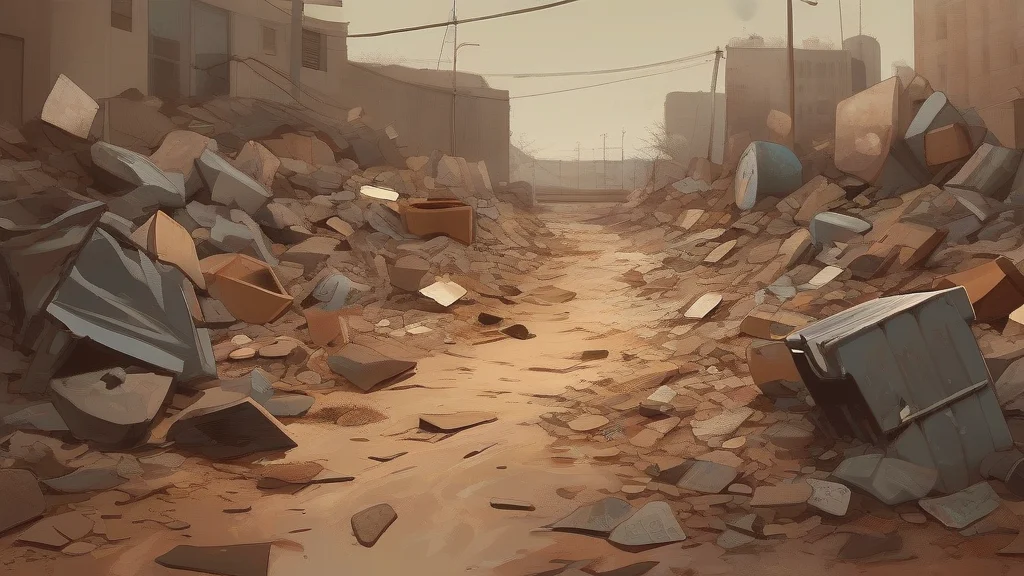
What does detritus mean?
Detritus refers to waste or debris, particularly the loose particles of rock or organic matter created by erosion, weathering, or decay. In geology and ecology it is an exact technical term — marine biologists, for example, study the detritus on the seafloor that feeds entire food webs. Beyond science, the word is used figuratively for the accumulated remnants or rubbish left behind by human activity: the detritus of war, of consumer culture, or of a once-thriving industry. It derives from Latin deterere, meaning "to rub or wear away," making it etymologically a cousin of "trite." The word has a formal, slightly literary register; it sounds more considered than "junk" or "litter" and suits descriptive or analytical writing. Its connotations are largely negative but neutral in tone — it names what remains when things break down, without implying fault.
nounWaste or debris of any kind, especially loose fragments of rock or organic matter produced by erosion, weathering, or decay. More generally, any accumulated rubbish or remnants left after something has been broken down or discarded.
- Loose fragments of rock or organic matter produced by weathering, erosion, or decay (especially in geology and ecology).
- Any accumulated waste, debris, or worthless remnants (figurative or general use).
"The beach was littered with the detritus of a long-abandoned fishing village."
"The streambed was covered with coarse detritus washed down from the mountains."
"After the festival ended, workers spent days clearing away the detritus left behind."
Detritus is almost always used as an uncountable (mass) noun; no plural form is in standard use. When a plural sense is needed, writers say "pieces of detritus" or "detrital deposits."
"The river carried tons of detritus downstream each spring."
"Detritus" comes from the Latin for "rubbing away" — the same root that gives us "trite," which literally means "worn out by overuse."
Reviewed by Deb Chak, Editor. AI-assisted content curated by RJS Tech Solutions LLP.
Etymology of detritus
Detritus comes from the Latin dētrītus, meaning "a rubbing away," derived from the verb dēterere ("to wear away, rub off"), itself formed from dē- ("away") plus terere ("to rub"). English adopted the word in the late eighteenth century as a geological term for rock worn into small fragments by erosion. It later broadened to cover organic debris and then waste matter of any kind. Words sharing the same Latin root include "attrition," "trite," and "contrite."
How detritus is actually used
In scientific writing (geology, marine biology), detritus is a precise technical term for particulate organic matter. In everyday usage it carries a slightly literary or elevated tone compared to plainer words like "rubbish" or "junk."
Easily confused with detritus
Debris refers specifically to scattered fragments from destruction or wreckage, while detritus more often denotes accumulated waste or eroded material, especially in geological and ecological contexts.