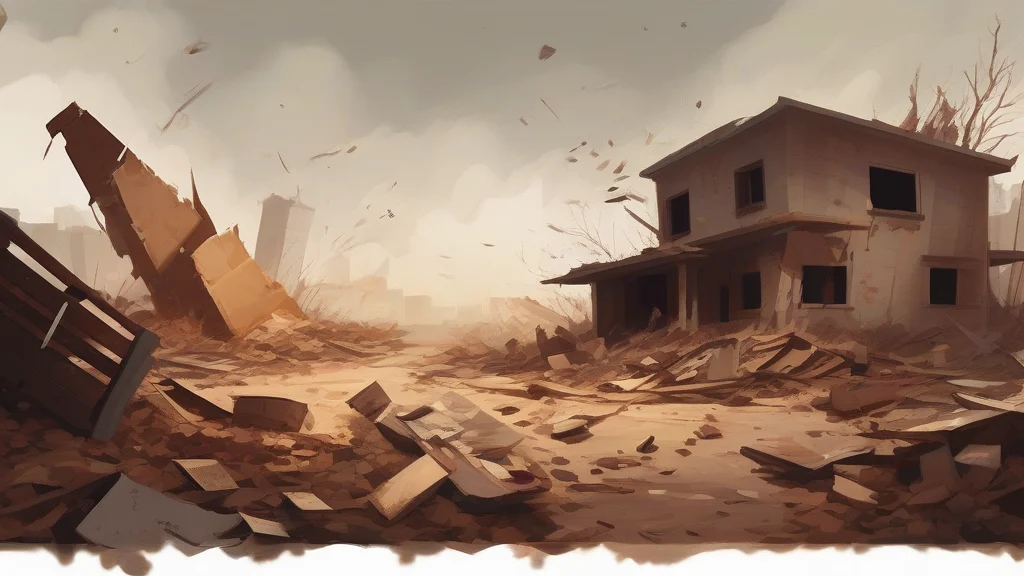
What does debris mean?
Debris is an uncountable noun referring to the scattered fragments, rubble, or wreckage left behind when something is broken, destroyed, or torn apart. It is most commonly used in the context of natural disasters, explosions, crashes, and construction or demolition work — one speaks of debris strewn across a road after a storm, a debris field at a crash site, or clearing debris from a building site. The word also appears in scientific registers: space agencies monitor orbital debris to protect satellites, while geologists describe rockfall and glacial debris. Because it cannot be counted or pluralized, speakers quantify it loosely as "a pile of debris," "pieces of debris," or "a great deal of debris." Borrowed from French in the early eighteenth century, debris retains a slightly formal or journalistic tone compared with plainer alternatives like "rubble," making it a staple of news reporting on accidents and destruction.
nounThe scattered remains of something broken or destroyed, such as rubble, fragments, or wreckage.
- Scattered pieces of something broken, destroyed, or discarded; wreckage or rubble.
"Rescue crews sifted through the debris of the collapsed building in search of survivors."
"The storm left debris strewn across the entire beach."
"Engineers track even the smallest debris orbiting the Earth to protect satellites from collisions."
Debris is a mass noun and does not have a plural form. Quantity is expressed through partitive constructions such as "pieces of debris" or "piles of debris."
"Volunteers gathered bag after bag of debris from the flood-damaged homes."
"Debris" is one of the few English words borrowed from French with a silent final "s" that English speakers simply refuse to pronounce — but the French never pronounced it either.
Reviewed by Deb Chak, Editor. AI-assisted content curated by RJS Tech Solutions LLP.
Etymology of debris
The English word debris was borrowed from French débris in the early eighteenth century, where it originally referred to the undigested remains of prey expelled by predators before broadening to mean scattered remnants generally. The French noun derives from the verb débriser, meaning "to break down or crush," formed from the prefix dé- plus briser ("to break"). Briser itself likely traces back through Vulgar Latin *brisiare to a Celtic or Germanic source related to breaking. Cognate forms appear across Romance languages, reflecting the shared root of breaking apart.
How debris is actually used
Debris is an uncountable noun in standard usage: it takes singular verbs ("the debris was everywhere") and has no conventional plural form. In American English it is most commonly pronounced /dəˈbriː/ or /ˈdeɪbriː/; British speakers typically say /ˈdɛbriː/. The word carries a neutral-to-negative connotation, strongly associated with accidents, disasters, demolition, and conflict.
Easily confused with debris
Debris refers to scattered fragments left by destruction or breaking, while detritus more often denotes loose organic matter or accumulated waste and grime.