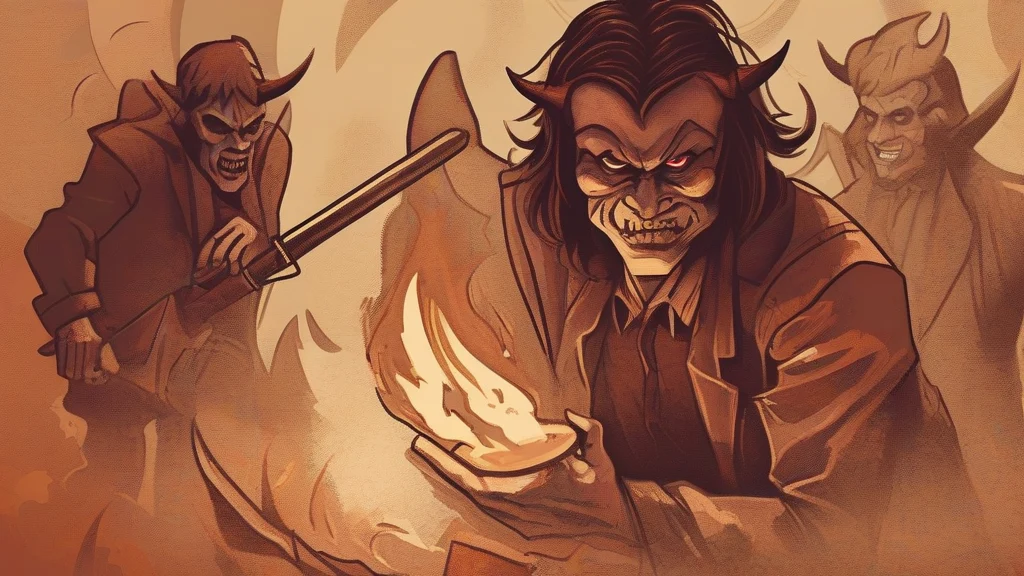
What does deviltry mean?
"Deviltry" is a noun meaning wicked or mischievous behavior — conduct that is either genuinely evil or playfully roguish, depending on context. The word is essentially an American variant of "devilry," formed from "devil" plus a suffix suggesting practice or character, and it emerged in the United States in the early nineteenth century. In its darker sense, deviltry describes malevolence or villainy, as when a story's antagonist engages in relentless deviltry; in its lighter sense, it captures spirited mischief — the gleeful naughtiness of children or the sly pranks of an impish friend. The word carries a distinctly literary, slightly archaic air, which makes it a colorful alternative to plainer terms like "mischief" or "wickedness." Writers reach for it precisely because it evokes both the demonic and the impish at once: deviltry can be sinister or charming, sometimes both in a single glance. Its plural, "deviltries," appears occasionally to refer to separate instances of such conduct.
nounWicked or mischievous behavior; reckless playfulness or roguish conduct.
- Wicked or evil behavior; conduct worthy of a devil.
- Mischievous or roguishly playful behavior; high spirits that shade into naughtiness.
"The children's harmless deviltry kept their grandmother amused all afternoon."
"The novel's villain commits acts of genuine deviltry without a flicker of remorse."
"There was a glint of pure deviltry in his eyes as he swapped the salt for sugar."
Rare; the word is usually uncountable, but the plural can denote individual instances of mischief or wickedness.
"His youthful deviltries were recounted fondly at every family gathering."
Coined in America in the early 1800s by adding a homegrown twist to the older British word "devilry," "deviltry" is one of those rare words invented simply to name mischief itself.
Reviewed by Deb Chak, Editor. AI-assisted content curated by RJS Tech Solutions LLP.
Etymology of deviltry
"Deviltry" derives from "devil," which traces back through Old English "dēofol" to Latin "diabolus" and Greek "diabolos" ("slanderer"). It was formed in America in the early nineteenth century as a variant of the older English word "devilry," substituting the suffix "-try" for "-ry." Both forms mean wicked or mischievous behavior, with "deviltry" becoming the standard American choice and "devilry" remaining more common in British usage.
How deviltry is actually used
"Deviltry" is primarily an American form, with "devilry" preferred in British English. It is somewhat literary and old-fashioned in flavor, often used with playful or affectionate connotation when describing mischief, but it can also carry serious moral weight when describing outright wickedness. It is uncountable in most uses, though a plural occurs occasionally for individual instances of mischief.
Easily confused with deviltry
"Devilry" is the older and chiefly British form of the same word, while "deviltry" is the common American spelling; both mean wicked or mischievous behavior.