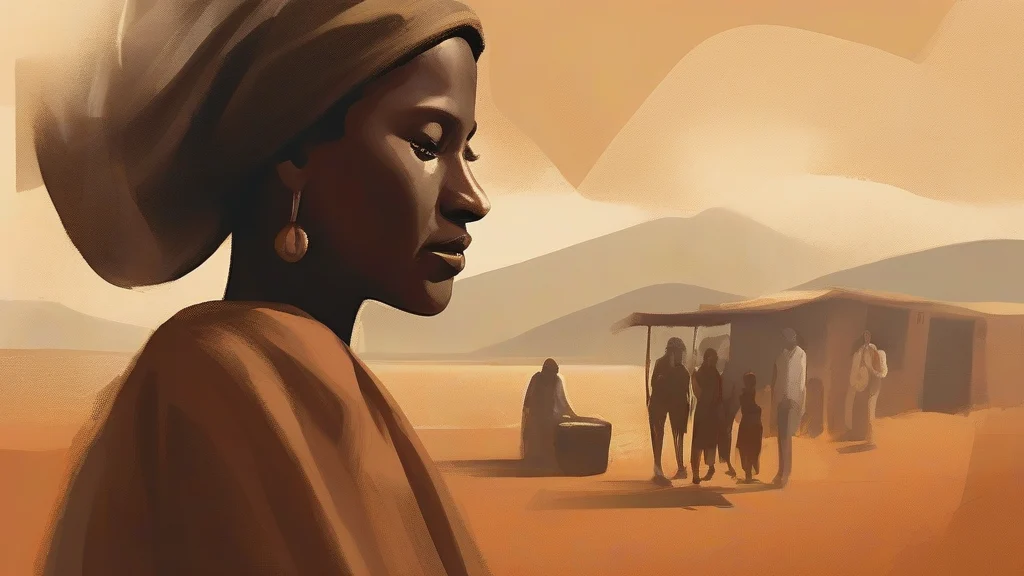
What does diaspora mean?
A diaspora is the dispersion of a population from its original homeland, and by extension the worldwide community formed by those who have settled elsewhere while retaining ties to their place of origin. The term was first applied to the Jewish exile from ancient Israel, and for centuries it carried primarily religious significance; since the mid-twentieth century it has broadened to describe groups such as the African, Irish, Armenian, and Indian diasporas. A diaspora typically arises through war, famine, persecution, slavery, or economic necessity, yet it often results in vibrant transnational communities that preserve language, cuisine, and tradition across generations. In contemporary usage the word appears in phrases like 'diaspora communities', 'diaspora politics', and 'diaspora literature'. While it can evoke displacement and loss, it also suggests endurance, adaptation, and the persistence of cultural identity across borders — making it an essential word for discussing migration, belonging, and globalization.
nounThe dispersion or spread of a people from their original homeland, or the community of people who live outside that homeland but maintain cultural ties to it.
- The dispersion of a people from their original homeland, especially by forced migration (e.g. the Jewish diaspora after the Babylonian exile).
- The collective body of people so dispersed, regarded as a single community maintaining ties to the homeland.
- More generally, any large-scale migration or scattering of a group away from an established or ancestral homeland.
"The Jewish diaspora spread communities across Europe, North Africa, and the Middle East over many centuries."
"Millions in the Irish diaspora trace their roots to families who fled famine and poverty in the nineteenth century."
"Social media has made it easier for diaspora communities to stay connected with events back home."
The plural is regular and typically appears when comparing several distinct displaced populations.
"Scholars of migration study diasporas across many different regions and eras."
The word diaspora literally means 'a sowing through' — ancient Greeks imagined scattered peoples as seeds flung across the earth, each one sprouting a new community far from home.
Reviewed by Deb Chak, Editor. AI-assisted content curated by RJS Tech Solutions LLP.
Etymology of diaspora
Diaspora comes directly from Greek 'diaspora', meaning 'a scattering' or 'dispersion', formed from 'dia-' ('through, across') and 'speirein' ('to sow'), so the word originally evoked seeds sown across the ground. It entered English in the late seventeenth century via Latin and French, initially referring almost exclusively to the Jewish exile described in scripture. From the twentieth century onward its use expanded to any people dispersed from an ancestral homeland. It shares the Greek root 'speirein' with words such as 'spore', 'sperm', and 'sporadic'.
Related word forms
How diaspora is actually used
Originally capitalized when referring specifically to the Jewish exile, the word is now usually lowercase and applies broadly to any dispersed population. It often carries connotations of loss or displacement but can also imply resilience and enduring cultural identity. Frequently used attributively, as in 'diaspora communities' or 'diaspora literature'.
Easily confused with diaspora
A diaphragm is a muscle or partition separating two areas, whereas a diaspora is a scattered population living away from its ancestral homeland.