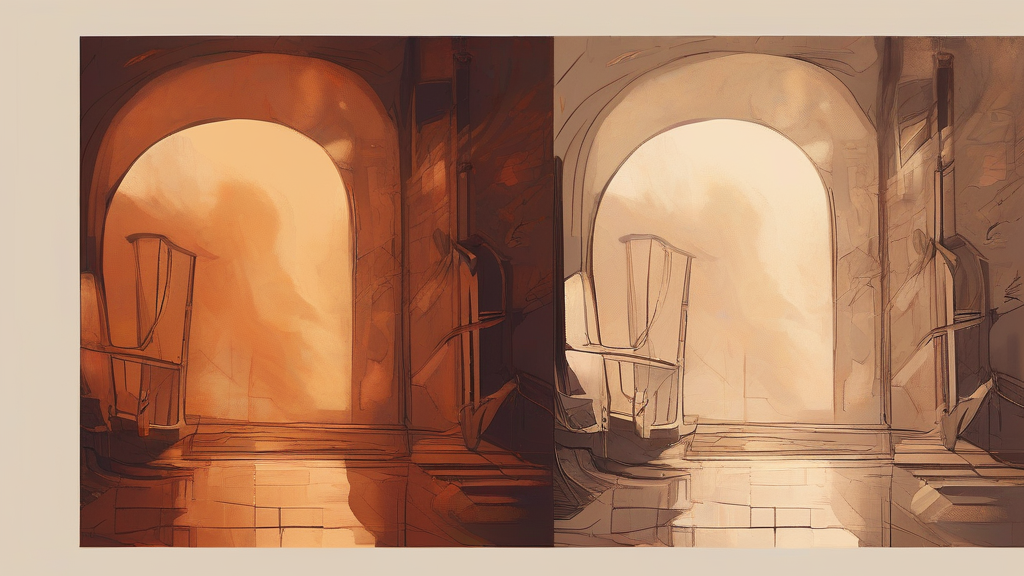
What does dichotomy mean?
A dichotomy is a sharp division of something into two mutually exclusive or strongly contrasting parts. The word is most often used figuratively to describe a perceived opposition — such as the dichotomy between mind and body, or between tradition and modernity — where two ideas are treated as irreconcilable opposites. In formal logic, it has a precise meaning: the partition of a set into exactly two exhaustive, non-overlapping classes. In biology, it describes branching patterns that split repeatedly into two, such as certain veins or root systems. Because critics often argue that real-world situations resist neat twofold divisions, the phrase 'false dichotomy' has become a staple of debate, used to challenge arguments that oversimplify by offering just two options. The word carries an intellectual, analytical tone and appears frequently in academic prose, journalism, and cultural commentary, making it valuable for describing tension, contrast, and conceptual structure with precision.
nounA division or contrast between two things that are represented as being opposed or entirely different; also, in logic and biology, a division into two mutually exclusive categories or a repeated branching into two parts.
- A division or contrast between two things presented as opposed or entirely different.
- (Logic) A division into two mutually exclusive, jointly exhaustive categories.
- (Biology/Botany) Repeated branching into two equal parts, as in some leaves, veins, or organisms.
"The novel explores the stark dichotomy between public virtue and private vice."
"There is a persistent dichotomy in her work between order and chaos."
"Presenting voters only two options creates a false dichotomy that ignores the full range of views."
Standard English plural; stress remains on the second syllable ('daɪ-KOT-uh-meez').
"The philosopher's work is full of useful dichotomies for classifying moral positions."
Every time someone calls an argument a 'false dichotomy,' they're using a word the ancient Greeks coined from 'to cut in two' — literally, to slice the world into halves.
Reviewed by Deb Chak, Editor. AI-assisted content curated by RJS Tech Solutions LLP.
Etymology of dichotomy
Dichotomy comes from the Greek 'dichotomia,' formed from 'dikha' (in two) and 'temnein' (to cut), so its literal sense is 'a cutting in two.' It entered English via scholarly Latin usage in the early 17th century, first in logical and theological contexts such as Christ's division into two natures. Its Greek roots make it a cousin of words like 'trichotomy,' which describes a threefold division rather than a twofold one.
Related word forms
How dichotomy is actually used
Formal register; common in academic writing, criticism, and political commentary. Frequently used in the phrase 'false dichotomy' to criticize arguments that wrongly reduce complex issues to two choices. The plural is 'dichotomies.'
Easily confused with dichotomy
A trichotomy is a division into three distinct parts or categories, whereas a dichotomy is a division into exactly two.