What does digastric mean?
"Digastric" is an anatomical term describing any structure made up of two fleshy parts, or "bellies," typically joined by an intermediate tendon. It functions primarily as an adjective — as in the digastric muscle — but also serves as a noun referring to that muscle itself. The digastric lies beneath the jaw, running from the mastoid region of the skull down to the hyoid bone and forward to the inner surface of the mandible; it assists in opening the mouth, swallowing, and stabilizing the hyoid. The word derives from Greek roots meaning "twice" and "belly," reflecting the muscle's distinctive double-bellied shape. Strictly technical in register, it appears in anatomy education, surgical writing, and clinical contexts, and it is valuable vocabulary for students of medicine, dentistry, and the life sciences.
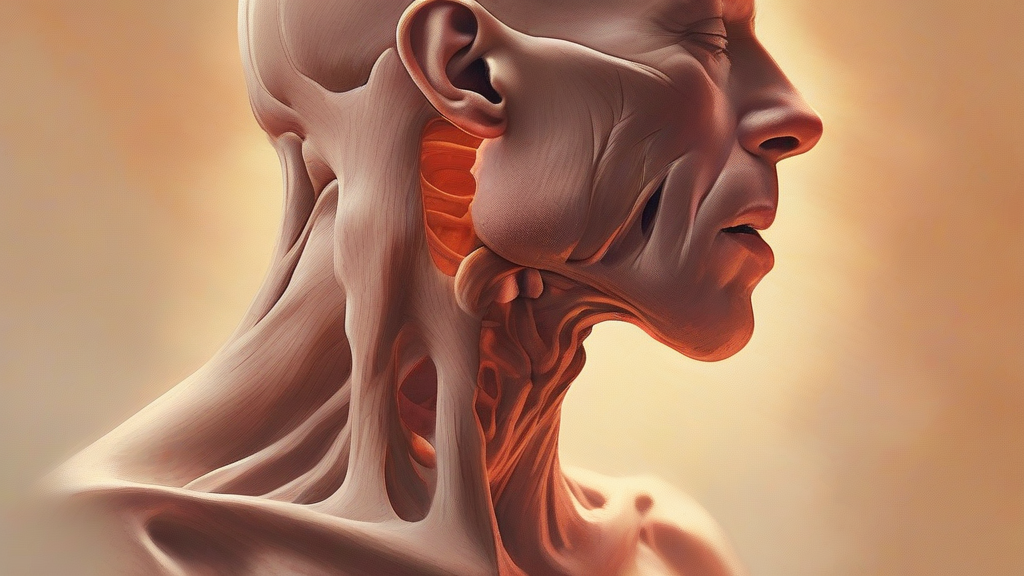
The digastric muscle: a two-bellied muscle running from the skull behind the ear to the mandible and hyoid bone, involved in opening the jaw and elevating the hyoid during swallowing.
"The digastric acts with other suprahyoid muscles to depress the mandible."
Used as a noun mainly in anatomy, where "the digastric" conventionally means the digastric muscle.
Having two bellies or fleshy portions, especially of a muscle divided into two fleshy parts by an intermediate tendon.
"The digastric arrangement allows the muscle to act across two different regions."
Rarely pluralized; when it occurs, "digastrics" refers to the paired digastric muscles on both sides of the body.
"Both digastrics were examined for signs of strain."
The digastric has one tendon but two 'bellies' — which is exactly why anatomists borrowed Greek for 'belly' twice and named it 'two-stomached'.
Reviewed by Deb Chak, Editor. AI-assisted content curated by RJS Tech Solutions LLP.
Etymology of digastric
The word digastric comes from New Latin digastricus, built on the Greek elements di-, meaning "two" or "twice," and gaster, meaning "belly" or "stomach." Anatomists coined it to describe muscles whose two fleshy bodies are separated by a tendon, since each fleshy portion resembles a belly. The same Greek root gaster gives English related terms such as gastric, gastropod, and epigastric. The term entered scientific English usage in the early modern period alongside the broader adoption of Latinate anatomical nomenclature.
How digastric is actually used
"Digastric" belongs almost entirely to formal medical and anatomical registers; it appears chiefly in anatomy textbooks, surgical literature, and clinical discussion rather than everyday speech. When used alone as a noun, it conventionally refers to the digastric muscle of the neck and jaw region.
Easily confused with digastric
Gastric relates to the stomach, while digastric describes a structure having two bellies, most famously the digastric muscle under the jaw.