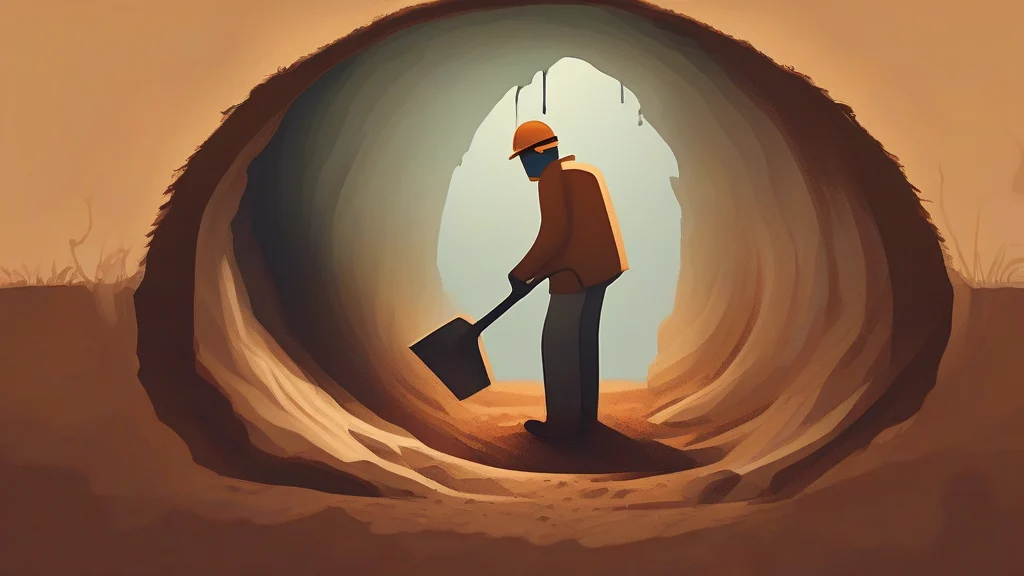
What does dig mean?
Dig is one of English's most versatile short verbs, fundamentally meaning to break up, loosen, and remove earth or similar material with a spade, hands, claws, or machinery. From this concrete core, its meanings branch naturally: one digs through a drawer searching for lost keys, a dog digs a hole under a fence, and investigators dig up information about a scandal. As a noun, a dig can mean an act of excavation — an archaeological dig being a famous instance — or, informally, a pointed critical remark aimed at someone, as in taking a dig at a rival. The word also carries a lively slang history: in twentieth-century American counterculture, saying you dug something meant you liked or appreciated it. Rooted in plain physical labour yet rich in figurative extension, dig serves equally well in gardening manuals, news reporting, archaeology, and casual conversation, making it both practical and expressive.
To break up and move earth or other material with a tool, hands, or machine; also, to search into or investigate thoroughly.
"We dug deep into the company's financial records to find the source of the losses."
Past tense "dug", past participle "dug". Common phrasal uses include "dig up", "dig out", and "dig into".
An act of digging; an archaeological excavation; or, informally, a cutting or sarcastic remark.
"His remarks about her driving were just a playful dig between old friends."
Plural "digs" can also refer, chiefly in British English, to lodgings rented by students or workers.
As a noun, "dig" forms the regular plural "digs". In British English, "digs" alone refers to rented lodgings.
"She moved out of her university digs after graduation."
In 1960s slang, to say you "dig" something meant you understood and loved it — the same word your spade uses to break ground.
Reviewed by Deb Chak, Editor. AI-assisted content curated by RJS Tech Solutions LLP.
Etymology of dig
The verb dig first appears in written English in the early seventeenth century, though it was almost certainly in spoken use well before that. Its origin is uncertain: it may derive from, or be related to, an Old French word meaning to dig or carve, possibly of Germanic origin. It has no established cognates in other languages that can be stated with confidence. Despite this murky ancestry, the word became firmly entrenched in English, spawning derivatives such as "digger" and idioms like "dig deep."
Related word forms
How dig is actually used
Highly versatile across registers: literal senses are neutral and everyday; figurative senses such as a "dig" (a jab or taunt) are informal but common. The slang sense meaning "to appreciate" is dated but recognizable from mid-20th-century American usage.
Easily confused with dig
"Dug" is the past tense of "dig" (or an animal's teat), whereas "dig" is the present-tense verb itself.