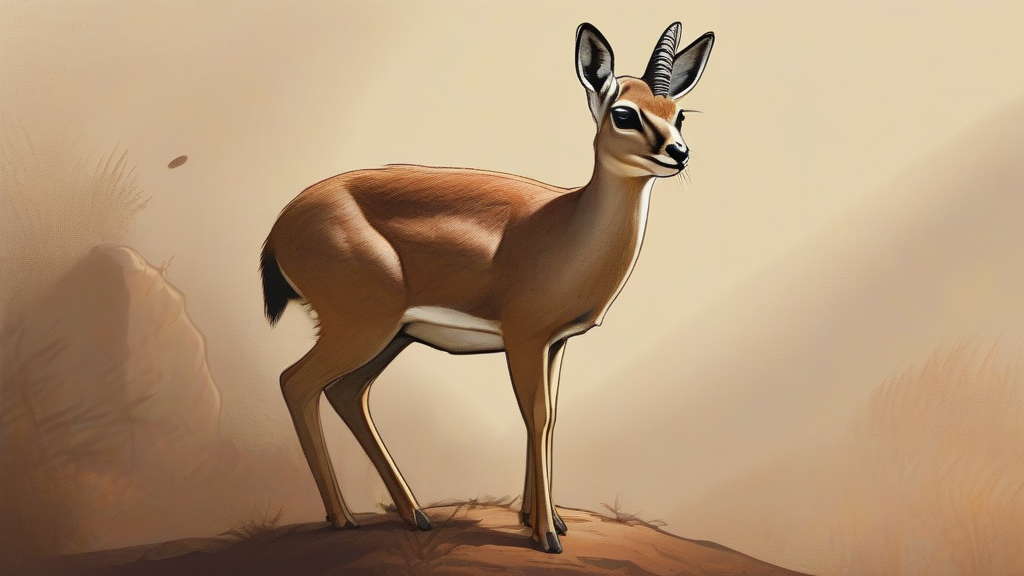
What does dikdik mean?
A dikdik is one of the smallest antelopes in the world, a shy, delicate animal of the genus Madoqua found in eastern and southwestern Africa. Standing only about thirty to forty centimetres high, it takes its name from the distinctive whistling alarm call it makes when startled, which sounds remarkably like the word itself. Dikdiks inhabit dry bushland and scrub, where their small size and sandy-brown colouring allow them to vanish into cover at the first sign of danger. Unusually among antelopes, they are largely monogamous, living in devoted pairs that share and defend a small territory. The word appears most often in natural-history writing, safari literature, and wildlife documentaries, and it may be spelled "dikdik" or hyphenated as "dik-dik." Its charming name and diminutive stature make it a favourite subject in writing about African wildlife.
nounA dikdik is a very small African antelope of the genus Madoqua, native to eastern and southwestern Africa and named for the alarm call it makes. It stands roughly 30–40 cm at the shoulder.
- A tiny antelope of the genus Madoqua, native to East Africa and parts of southwestern Africa, known for its distinctive alarm call that resembles its name.
"The dikdik darted into the thorn scrub before we could raise our binoculars."
"We watched a dikdik slip quietly through the acacia brush at dawn."
"Unlike most antelopes, dikdiks are monogamous, with pairs defending a small territory together."
The regular plural "dikdiks" is standard; some writers leave the noun unchanged, and the hyphenated spelling "dik-dik" gives "dik-diks."
"The reserve is home to several pairs of dikdiks."
The dikdik is so small it can fit in a person's arms — and its name is simply the sound of its own alarm call.
Reviewed by Deb Chak, Editor. AI-assisted content curated by RJS Tech Solutions LLP.
Etymology of dikdik
The word "dikdik" comes from an indigenous language of East Africa and is onomatopoeic, imitating the animal's characteristic alarm call. It was adopted into English during the nineteenth century, when European explorers and naturalists recorded local names for the region's fauna. The term has remained stable since then, with no significant change in form or meaning.
How dikdik is actually used
"Dikdik" may also be written "dik-dik"; both spellings are accepted, and the plural is typically "dikdiks" or unchanged. The word is used chiefly in zoological, safari, and natural-history contexts rather than everyday conversation.
Easily confused with dikdik
A gazelle is a much larger, long-legged antelope of open plains, whereas a dikdik is one of the smallest antelopes, adapted to dense bush.