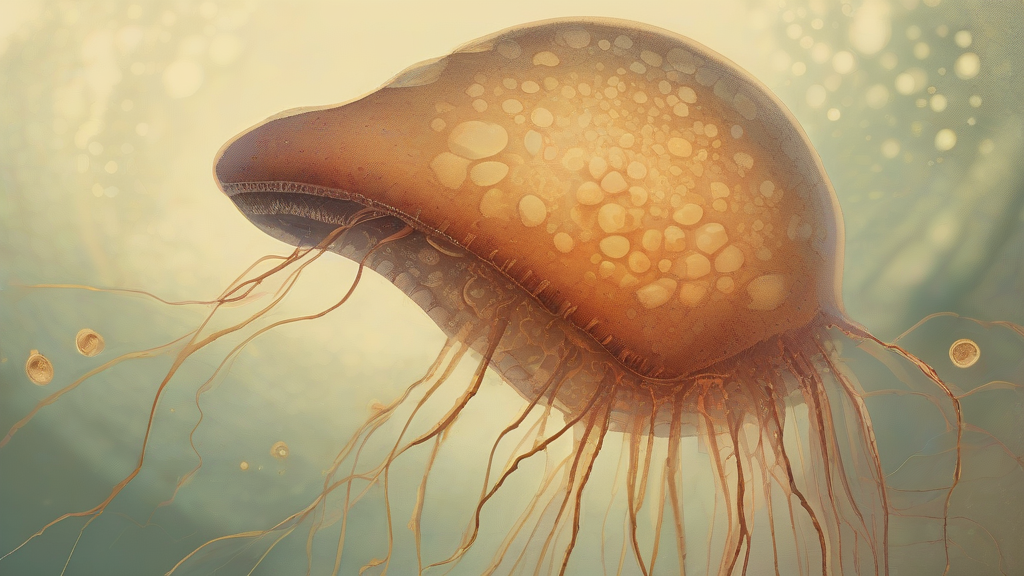
What does dinoflagellate mean?
A dinoflagellate is a microscopic, mostly single-celled organism belonging to the phylum Dinoflagellata, found chiefly in marine environments but also in fresh water. Each cell typically bears two flagella — whip-like appendages — one wrapped around a groove encircling the body and the other trailing behind, giving these organisms their characteristic spinning motion. Many dinoflagellates are photosynthetic and form a vital foundation of ocean food webs as part of phytoplankton, while others feed on bacteria or other plankton. The word carries strong associations with dramatic natural phenomena: certain species produce spectacular bioluminescent displays that make seawater glow blue at night, and others cause harmful algal blooms known as red tides, which can release toxins dangerous to fish and to humans who eat contaminated shellfish. Used mainly in scientific, educational, and journalistic contexts, dinoflagellate is an essential term for anyone reading about ocean ecology, climate research, or coastal environmental issues.
nounA dinoflagellate is a single-celled aquatic organism, typically marine, belonging to the phylum Dinoflagellata, characterized by the presence of two flagella used for locomotion. Many species are photosynthetic and form a major component of plankton, while some are responsible for bioluminescence or harmful algal blooms such as red tides.
- Any of numerous single-celled aquatic protists of the phylum Dinoflagellata, typically bearing two unequal flagella, many of which are photosynthetic and form part of marine plankton.
"The glowing waves along the shore were caused by millions of bioluminescent dinoflagellates."
"Scientists monitored the bay closely after a bloom of toxic dinoflagellates threatened shellfish beds."
"Under the microscope, each dinoflagellate revealed its distinctive pair of flagella grooved into protective cellulose plates."
The standard plural simply adds -s; the plural is used when referring to multiple organisms or multiple species collectively.
"Bioluminescent dinoflagellates illuminate the surf at night in several tropical bays."
Some dinoflagellates light up the ocean at night — the eerie blue glow in breaking waves is literally billions of them flashing in unison.
Reviewed by Deb Chak, Editor. AI-assisted content curated by RJS Tech Solutions LLP.
Etymology of dinoflagellate
The word dinoflagellate derives from the modern Latin taxonomic name Dinoflagellata, formed from the Greek prefix dino- (from Greek 'deinos,' meaning 'whirling' or 'terrible') combined with 'flagellum,' the Latin word for a small whip. The name refers to the organisms' whirling swimming motion produced by their two flagella. The term entered English scientific vocabulary in the late nineteenth century as microscopists formalized the classification of these protists, and it shares its root elements with related terms such as flagellum, flagellate, and the combining form dino- seen in other scientific names.
How dinoflagellate is actually used
Dinoflagellate is a technical term used primarily in biology, oceanography, and environmental science; it appears rarely in casual conversation but is common in scientific literature and journalism about red tides, harmful algal blooms, and bioluminescent seas.
Easily confused with dinoflagellate
Diatoms are a different group of single-celled algae with silica cell walls, whereas dinoflagellates are flagellated protists with two whiplike appendages.
Flagellate is a broader term for any organism that moves using flagella, while dinoflagellate refers specifically to members of the phylum Dinoflagellata.