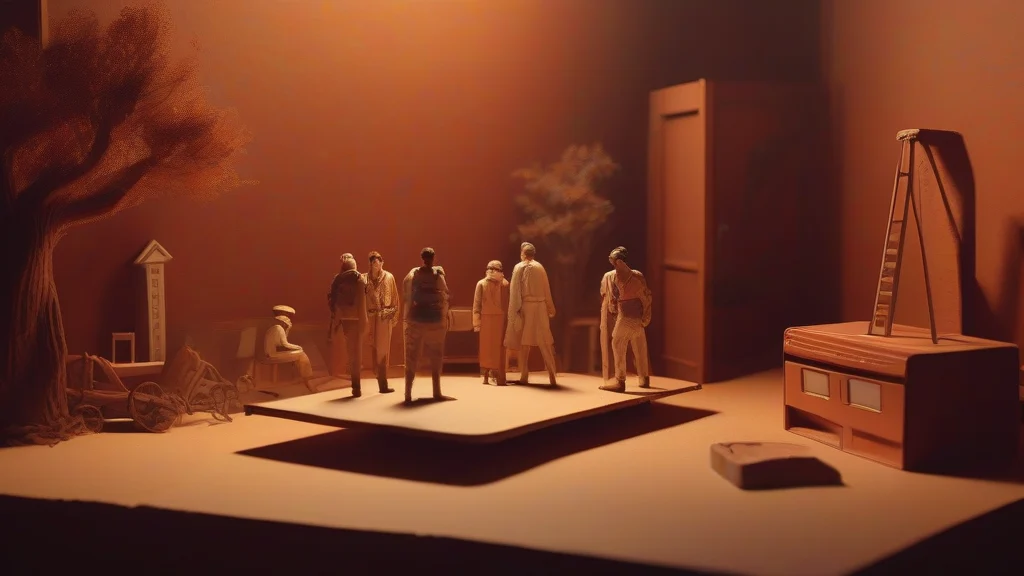
What does diorama mean?
A diorama is a three-dimensional representation of a scene, constructed either in miniature — such as a child's shoebox project depicting a rainforest — or at full scale, as seen in the celebrated habitat displays of natural history museums. The term also refers to a once-fashionable form of nineteenth-century entertainment: staged painted scenes viewed through an aperture, their moods transformed by cleverly manipulated lighting, invented by Louis Daguerre in Paris in the early 1820s. Today, the word most often evokes meticulous craftsmanship, patient attention to detail, and educational display; a well-made diorama can transport viewers into another world within the confines of a glass case. Derived from Greek roots meaning 'through' and 'to see', it sits alongside related coinages like 'panorama' and 'cyclorama'. Whether encountered in a museum hall or a classroom, the word suggests a carefully framed window onto a captured moment.
A three-dimensional model of a scene, either miniature or life-size, displayed in a case or purpose-built setting.
"The museum's newest diorama recreates a tidal marsh teeming with sculpted shorebirds."
Most commonly used of museum habitat displays and school craft projects.
(Historical) A form of optical entertainment, popular in the early nineteenth century, in which painted scenes viewed through an opening appeared to change through variations in lighting.
"Audiences marvelled as the diorama's moonlit harbour dissolved slowly into morning mist."
Now chiefly of historical interest, appearing in discussions of pre-cinematic visual culture.
Regular plural formation; used both for multiple models and for multiple instances of the historical entertainment.
"The gallery's Victorian dioramas have delighted visitors for over a century."
The word 'diorama' was coined by Louis Daguerre — the same inventor behind the daguerreotype photograph — for a dazzling Parisian light-and-shadow spectacle he opened in 1822.
Reviewed by Deb Chak, Editor. AI-assisted content curated by RJS Tech Solutions LLP.
Etymology of diorama
Diorama was coined in French by the inventor Louis Daguerre around 1822 for his popular optical spectacle in Paris, combining the Greek roots dia- ('through') and horama ('that which is seen', from horan, 'to see'). The same root horan underlies the earlier coinage panorama (late eighteenth century) and the later cyclorama. English adopted the word shortly after its French debut, first for the theatrical medium and soon after for any three-dimensional scenic model.
How diorama is actually used
The word carries connotations of careful craftsmanship and educational display. It is common in museum contexts (natural history habitat dioramas) and in school settings, where children build shoebox dioramas as projects. The historical theatrical sense is now largely obsolete but appears in writing about nineteenth-century visual culture.
Easily confused with diorama
A panorama is a wide, unbroken view of an entire surrounding landscape, while a diorama is a physical three-dimensional model of a scene.
A cyclorama is a large curved backdrop used in theatre to suggest unlimited space, whereas a diorama is a three-dimensional scenic model.