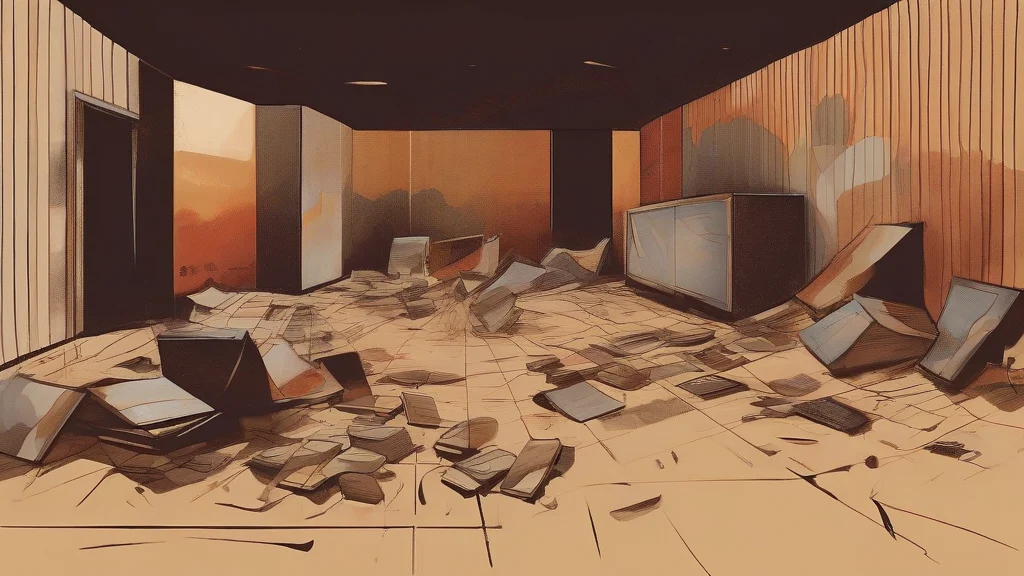
What does disarrayed mean?
"Disarrayed" is an adjective describing something or someone thrown into disorder, whether physically untidy or figuratively confused and disorganized. It most commonly appears as the past-participle form of the verb "disarray," meaning to disturb the arrangement or composure of something. The word can describe a person whose appearance has become rumpled — disarrayed hair, disarrayed papers — or, more broadly, a group, institution, or plan that has lost its structure and coherence: an army left disarrayed by a surprise attack, or a government disarrayed by scandal. The term derives from "array," which originally referred to troops drawn up in orderly ranks; to be "disarrayed" is thus etymologically to have one's ranks broken. In modern usage it tends toward a formal or literary register, carrying the connotation of a prior order that has been disrupted rather than simple messiness. Its noun counterpart, "in disarray," remains the more frequent expression in everyday English.
adjectiveIn a state of disorder or confusion; untidy, disorganized, or thrown into chaos. It is chiefly the past-participial adjective of the verb 'disarray'.
- (Of a person's appearance) untidy, rumpled, or unkempt — e.g., disarrayed clothing or hair.
- (Of a group, organization, or system) thrown into disorder or confusion; lacking coordination.
"The soldiers stood disarrayed on the field, their formations broken by the sudden retreat."
"He arrived at the interview disarrayed, his tie askew and his notes spilling from his bag."
"After the scandal broke, the once-disciplined campaign team was left thoroughly disarrayed."
Before it meant 'in disorder', 'array' meant troops drawn up in battle formation — so calling someone 'disarrayed' is literally saying their ranks have been broken.
Reviewed by Deb Chak, Editor. AI-assisted content curated by RJS Tech Solutions LLP.
Etymology of disarrayed
The word traces back through Middle French "desarroy" to the verb "array," from Old French "areier" meaning to put in order or draw up in ranks, ultimately of Germanic origin related to words for being ready or arranged. "Disarray" entered English in the late Middle Ages, first denoting a breakdown of military order before broadening to mean any state of disorder or confusion. The participial adjective "disarrayed" follows the same path, describing whatever has been stripped of its arrangement. Cognates include "array" and "rank," both preserving the original sense of ordered formation.
Related word forms
How disarrayed is actually used
The participial adjective form is somewhat less common than the noun 'disarray', which typically appears in the phrase 'in disarray'. As an adjective, 'disarrayed' carries a slightly literary or formal register and often implies that order once existed but has been lost.
Easily confused with disarrayed
'Disarray' is the noun (or base verb) meaning disorder itself, while 'disarrayed' is the adjective describing something that has been put into such a state.
'Disheveled' describes a rumpled, unkempt personal appearance, especially of hair or clothing, whereas 'disarrayed' applies more broadly to any person, group, or thing in a state of disorder.