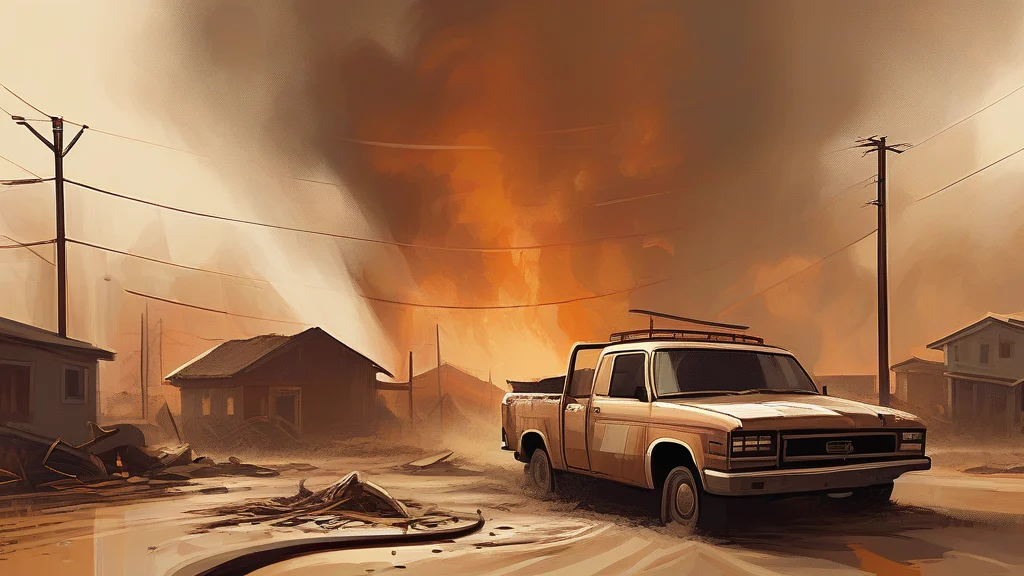
What does disaster mean?
A disaster is a sudden event — such as an earthquake, flood, fire, or accident — that causes serious damage, loss of life, or widespread suffering. The word carries strong negative connotations and is typically reserved for events of significant scale; minor inconveniences do not usually qualify. Beyond its literal sense, disaster is widely used informally and hyperbolically to describe anything that goes badly wrong, from a failed dinner party to a disastrous haircut, as in 'the presentation was a complete disaster.' This figurative use is common in casual speech but avoided in formal reporting. Common pairings include 'natural disaster,' 'disaster strikes,' and 'a recipe for disaster.' Derived forms include the adjective 'disastrous' and its adverb 'disastrously.' The word traces back to the Italian 'disastro,' meaning 'ill-starred,' reflecting the ancient belief that misfortune was written in the stars. Its blend of gravity and everyday flexibility makes it one of English's most versatile words for things going wrong.
A sudden event, such as an accident or natural catastrophe, that causes great damage, loss of life, or suffering.
"Flood relief teams were dispatched after the disaster struck the coastal region."
In official contexts, 'disaster' has specific legal definitions governing emergency declarations and aid eligibility.
Informal: a person or thing regarded as a complete failure.
"The wedding cake collapsed — it was a total disaster."
Hyperbolic and informal; common in conversational British and American English.
Regular plural; used when referring to multiple distinct catastrophic events or failures.
"The region suffered two major disasters in a single decade."
Disaster literally means 'bad star' — for centuries people blamed their misfortunes on planets being in the wrong position.
Reviewed by Deb Chak, Editor. AI-assisted content curated by RJS Tech Solutions LLP.
Etymology of disaster
Disaster entered English in the late 16th century via French 'désastre,' borrowing ultimately from Italian 'disastro.' The Italian word combines the prefix 'dis-' (expressing negation) with 'astro' (star), from Latin 'astrum,' itself from Greek 'astron.' It thus literally meant 'bad star,' reflecting the astrological belief that a planet's unfavorable position caused misfortune. Cognates sharing the same Latin root include 'astrology,' 'astral,' and 'asterisk.'
Related word forms
How disaster is actually used
Neutral-to-formal register when referring to catastrophes; strongly informal and often hyperbolic when describing personal failures ('my hair is a disaster'). In official contexts such as government declarations, 'disaster' has precise legal meanings tied to emergency response.
Easily confused with disaster
Catastrophe implies a final, ruinous end-state of extreme magnitude, while disaster refers to a sudden damaging event and can also be used lightly for everyday mishaps.
Calamity emphasizes prolonged distress and misfortune over time, whereas disaster stresses the sudden and unexpected nature of the event.