What does dishelm mean?
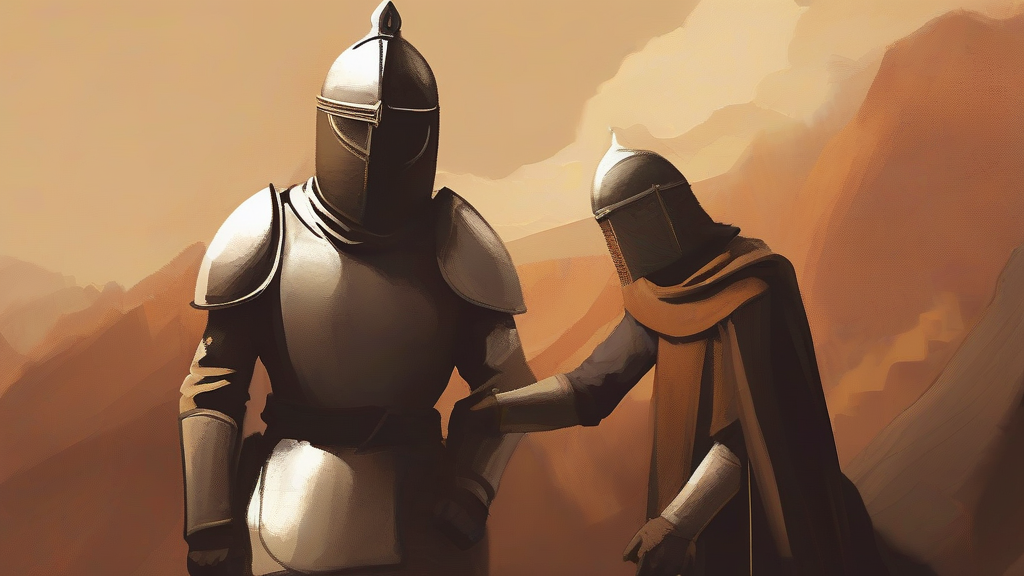
To dishelm is to remove a helmet — whether from oneself or another — typically in a context of medieval combat, ceremony, or courtesy. The word is built from the prefix 'dis-' and 'helm', the old word for protective headgear, and belongs to the small family of verbs describing the uncovering or donning of armour. It carries strong connotations of revelation and vulnerability: in chivalric romance and historical writing, the moment a knight is dishelmed is often charged with meaning — a sign of defeat when done by an enemy, of surrender or truce, or of respect when done before a superior or a lady. Because modern life offers few helmets to remove, 'dishelm' has become rare and distinctly literary, surviving chiefly in historical fiction, fantasy writing, and accounts of tournaments. Its precision makes it useful where plainer words like 'uncover' would lose the specific image of lifting away steel from a warrior's face.
verbTo remove the helmet from someone; to deprive of a helmet or head covering, often in battle or as a gesture of surrender or respect.
- To remove the helmet from someone; to strip or deprive of head armour.
"The squire stepped forward to dishelm the victorious knight."
"The defeated knight knelt as his opponent moved to dishelm him."
"She dishelmed after the joust, letting the crowd see her face."
Rare enough that most dictionaries barely record it, 'dishelm' captures a single dramatic gesture: the moment a knight's face is revealed.
Reviewed by Deb Chak, Editor. AI-assisted content curated by RJS Tech Solutions LLP.
Etymology of dishelm
Dishelm combines the prefix 'dis-', indicating removal or reversal, with 'helm', a word for protective head covering inherited from Old English and Old Norse. The formation parallels other 'dis-' verbs of stripping or undoing that arose in Middle and Early Modern English. It remains a rare literary word, with its closest relative being the similarly scarce 'unhelm'.
How dishelm is actually used
A rare, chiefly literary or archaic verb; it survives mostly in historical fiction and descriptions of chivalric ceremony rather than everyday speech.
Easily confused with dishelm
'Dishevel' means to untidy or rumble hair and clothing, while 'dishelm' specifically means to remove a helmet.