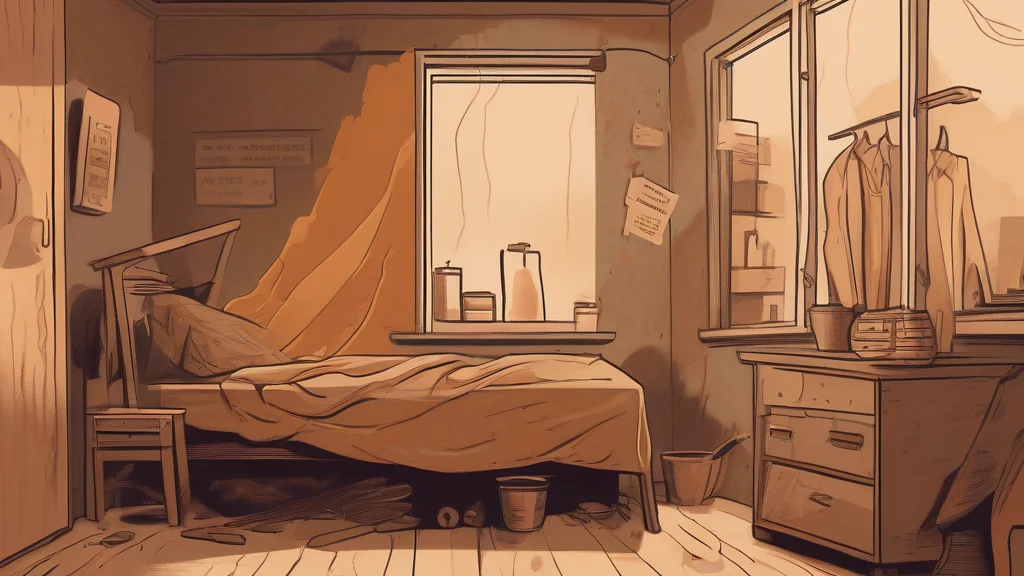
What does dishevelment mean?
Dishevelment is a noun describing the state of looking untidy, rumpled, or unkempt, especially with regard to the hair or clothing. Someone emerging from bed, caught in high winds, or rushing through a crisis might be described as being in a state of dishevelment. The word derives from 'disheveled,' which traces back through Old French to the Latin capillus, meaning 'hair,' so at root it refers literally to hair hanging loose. Though it most often describes personal appearance, it can extend metaphorically to any scene or arrangement marked by disorder. Dishevelment is relatively formal in register and appears mostly in written or literary English rather than casual conversation. It can carry a faintly critical tone when applied to people, implying neglect or lack of polish, yet writers also use it positively to evoke an attractive, artful looseness. It remains a precise, evocative choice for describing physical disorder.
nounThe state of a person's hair or clothing being untidy, rumpled, or hanging loose; more broadly, a general appearance of disorder or untidiness.
- The condition of being untidy or rumpled in appearance, especially of the hair or clothes.
- A broader sense of disorder or disarray in one's general presentation.
"She arrived at the interview breathless and in complete dishevelment, her coat buttoned wrong."
"After the storm, he emerged from the tent in total dishevelment, his sleeping bag dragging behind him."
"The portrait captured her elegant dishevelment — artfully loose curls and an unbuttoned collar that suggested rather than concealed."
Rarely used in the plural; the word almost always appears as an uncountable mass noun describing a general state.
"The novel catalogues the hero's various dishevelments across three chaotic days."
Hidden inside 'dishevelment' is the Latin word for 'hair' — capillus — because to be disheveled originally meant nothing more than having your hair down.
Reviewed by Deb Chak, Editor. AI-assisted content curated by RJS Tech Solutions LLP.
Etymology of dishevelment
Dishevelment comes from the verb 'dishevel,' formed on 'disheveled,' which entered Middle English from Anglo-Norman and Old French 'deschevelé,' meaning 'with the hair loose.' That French word combines the prefix 'des-' (indicating reversal) with 'chevel,' from Late Latin 'capellus,' a diminutive of Latin 'capillus,' meaning 'hair.' English speakers later added the noun-forming suffix '-ment' to create 'dishevelment,' following the pattern of words like 'development.' Cognates sharing the Latin hair-root include 'capillary.'
Related word forms
How dishevelment is actually used
Dishevelment is a somewhat formal or literary word, less common in everyday speech than its adjective counterpart 'disheveled.' It carries a mildly judgmental connotation when applied to people, though writers sometimes use it approvingly to describe a deliberately casual, romantic look.
Easily confused with dishevelment
Development means growth or advancement, while dishevelment means untidiness — they share a similar ending but are unrelated in meaning.