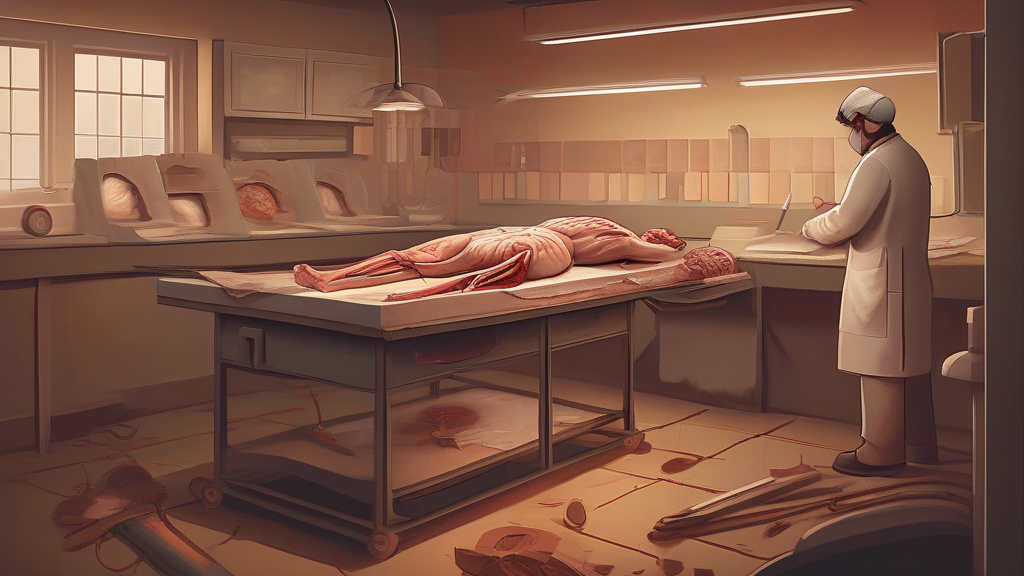
What does dissection mean?
Dissection is the act of carefully cutting apart a body, organism, or structure in order to study its internal organization, most familiarly from school biology classes where specimens such as frogs or flowers are examined piece by piece. The word extends naturally into figurative territory: journalists, critics, and scholars speak of a dissection of an argument, a policy, or a work of art when they subject it to detailed, methodical scrutiny. This analytical sense carries a slightly forensic flavor, suggesting rigor and perhaps a degree of unsparing criticism. Dissection derives from the Latin dissecare, meaning 'to cut apart', and entered English in the early modern period alongside the rise of anatomical science. A related but distinct medical usage describes an aortic dissection, a tear in a blood vessel wall — a reminder that context shapes meaning. Precise, clinical, and versatile, dissection remains indispensable in both scientific and intellectual vocabulary.
nounThe action or process of cutting apart, especially the careful dismembering of a plant or animal body in order to study its structure. More broadly, a detailed critical analysis or examination of something.
- The act of cutting apart a body, organism, or structure to examine its parts.
- A detailed analysis or breakdown of something abstract, such as an argument or text.
"The biology students performed a dissection of a frog to learn about its internal anatomy."
"The anatomy class began with the dissection of a preserved heart."
"Her essay offers a sharp dissection of the novel's central themes."
Standard plural; commonly used when referring to multiple procedures, studies, or analyses.
"His early dissections laid the groundwork for modern anatomy."
The word dissection literally means 'to cut apart' — and for centuries it was so taboo that some Renaissance anatomists risked execution to do it.
Reviewed by Deb Chak, Editor. AI-assisted content curated by RJS Tech Solutions LLP.
Etymology of dissection
Dissection comes from Latin dissecare ('to cut apart'), formed from dis- ('apart') and secare ('to cut'), the same root that gives us section, sector, and insect. The noun was formed on dissect, which English adopted in the early 17th century during the flourishing of anatomical study. Its figurative use for detailed analysis developed soon after, extending the cutting metaphor to arguments and texts.
Related word forms
How dissection is actually used
Dissection is largely neutral to formal in register; in medical and academic contexts it is standard terminology. In figurative use (a dissection of an argument), it often carries a slightly critical or forensic connotation, implying close, sometimes unsparing scrutiny. In medicine, 'dissection' also has a specialized sense — e.g. an aortic dissection — referring to a tear in a blood vessel wall, which is unrelated to deliberate cutting.
Easily confused with dissection
"Disection" is not a word — it is simply a common misspelling of "dissection", which always contains a double s.