What does djembe mean?
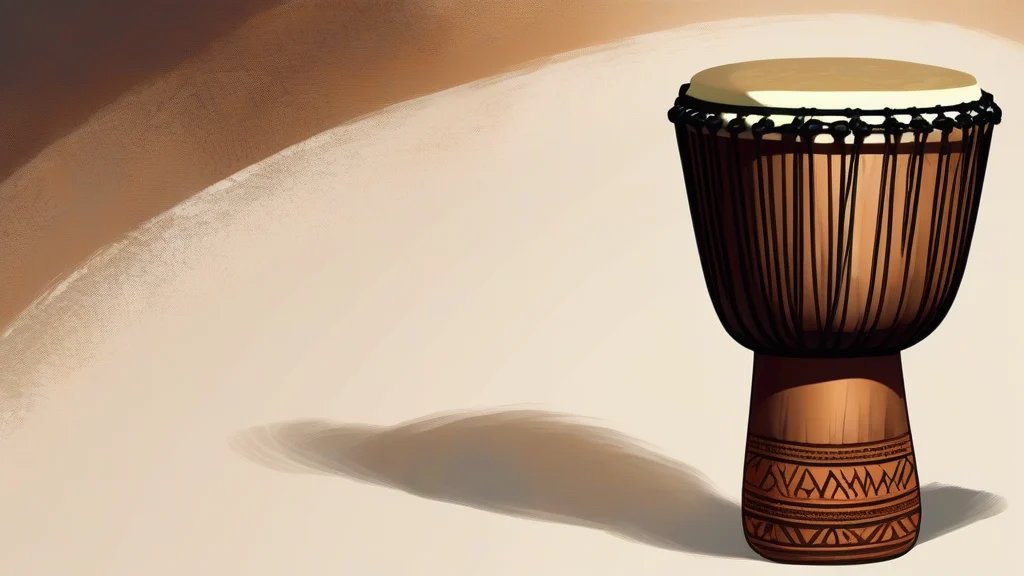
A djembe is a rope-tuned, goblet-shaped hand drum that originated among the Mandinka people of West Africa, particularly in present-day Mali, Guinea, and Senegal. Carved traditionally from a single trunk of hardwood and covered with untreated goatskin, it is played with bare hands using distinct strokes — bass, tone, and slap — that produce a remarkably wide range of sounds from one drum. The djembe occupies a central place in West African communal life, historically accompanying celebrations, rites of passage, and storytelling, where master drummers lead ensembles of dunun drums. Since the mid-twentieth century, touring artists such as Mamady Keïta brought the instrument to global audiences, and it has since become a fixture of world music, percussion education, and community drum circles worldwide. Its name derives from the Bambara language, often glossed as an invitation for people to gather together.
nounA goblet-shaped hand drum of West African origin, typically carved from a single piece of wood and topped with goatskin, played with the bare hands.
- A goblet-shaped West African hand drum with a skin head, played with the bare hands.
"The drummer's palms blurred across the djembe, driving the dancers into the night."
"She learned to play the djembe during a drumming workshop in Accra."
"The ensemble blended kora, balafon, and djembe into an irresistible rhythm."
Both the unchanged plural 'djembe' (following some English borrowings from African languages) and the anglicized 'djembes' appear in print; 'djembe' is common in specialist ethnomusicological writing, while 'djembes' is more frequent in general usage.
"The troupe arrived with six djembe and two dunun drums."
The djembe is said to be named after the Bambara saying 'Anke djé, anke bé' — 'everyone gather together in peace' — which is exactly what its sound was made to do.
Reviewed by Deb Chak, Editor. AI-assisted content curated by RJS Tech Solutions LLP.
Etymology of djembe
The word 'djembe' comes from the Bambara (Bamana) language of Mali, where the instrument is central to traditional music. It is popularly linked to the Bambara phrase 'Anke djé, anke bé' ('everyone gather together'), though the precise derivation of the name is not firmly documented. The drum itself originates with the Mandinka peoples of the Mali Empire region, with a history stretching back several centuries. The term entered English through French ethnographic writing on West Africa in the twentieth century, spreading more widely as the instrument gained international popularity after World War II.
How djembe is actually used
The word is often preceded by 'the' when referring to playing it ('play the djembe'). The plural is usually 'djembe' or 'dembes'; both 'djembes' and unchanged 'djembe' are seen in English texts.
Easily confused with djembe
Bongos are a pair of small, shallow drums played with the hands and held between the knees, while a djembe is a single tall, goblet-shaped drum played while standing or on a strap.