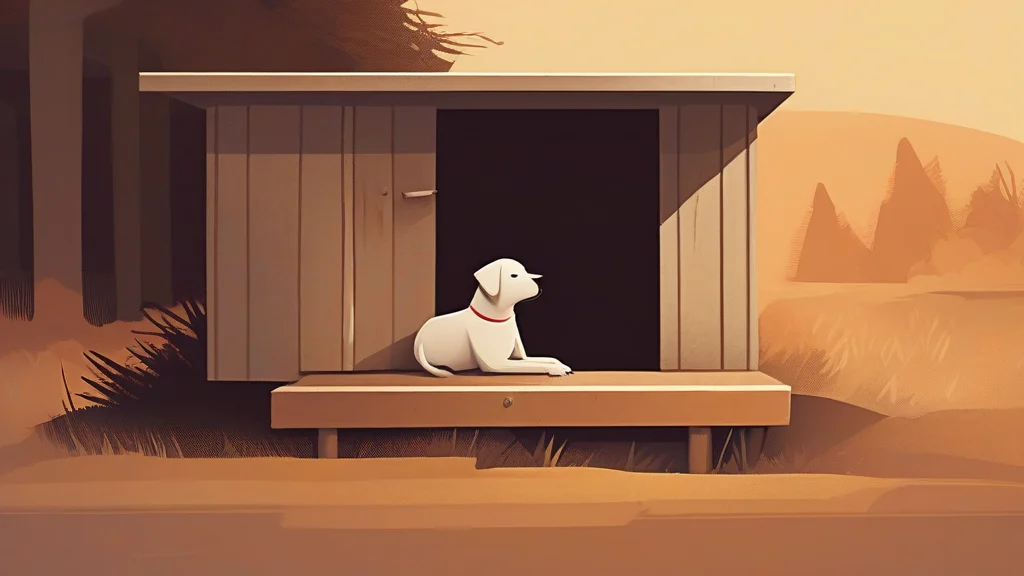
What does doghouse mean?
A doghouse is a small outdoor structure designed to give a dog protection from weather and a place to sleep. Built typically from wood or plastic, it ranges from simple boxes to elaborate miniature houses, and remains a familiar feature of backyards, especially in North America, where 'doghouse' is the standard everyday term (British English more often uses 'kennel'). The word also thrives figuratively: to be 'in the doghouse' means to be out of favour with someone — usually a spouse, parent, boss, or friend — after some lapse or misdeed. This idiomatic sense, informal and chiefly American though broadly understood, conveys mild, often affectionate disapproval rather than lasting anger; one might be in the doghouse for forgetting an anniversary or missing a deadline. Few household words manage such a tidy double life: a humble shelter for pets has become one of the language's most vivid shorthand expressions for domestic disgrace.
A small outdoor shelter in which a dog can sleep or take refuge from the weather.
"The wind was howling, so the retriever retreated into her doghouse."
In British English, 'kennel' is the more usual term for this object; 'doghouse' is standard in North America.
(Informal, usually in the phrase 'in the doghouse') A state of disfavour or temporary punishment resulting from having annoyed someone.
"Since he missed the school play, he's been in the doghouse all week."
Almost always used with the preposition 'in'; chiefly North American but widely understood.
The plural simply adds -s, following regular noun inflection.
"The animal shelter sells hand-built doghouses to raise funds."
In American English, you can be literally in the doghouse — or figuratively, which is where millions of misbehaving partners end up every day.
Reviewed by Deb Chak, Editor. AI-assisted content curated by RJS Tech Solutions LLP.
Etymology of doghouse
Doghouse is a transparent compound of 'dog' and 'house', both ancient Germanic words; Old English 'docga' gave 'dog', while 'house' derives from Old English 'hūs'. The compound arose naturally as people built shelters for their animals, with written evidence dating from around the early 19th century. Its figurative use — being 'in the doghouse' for being in disgrace — developed later, becoming widespread in mid-20th-century American English, likely by analogy with a naughty dog sent outdoors to its shelter. It shares its Germanic roots with cognates such as German 'Haus' and Dutch 'huis' (house) and German 'Dogge' (a breed of dog).
How doghouse is actually used
The literal sense is neutral and common. The figurative sense — always in the phrase 'in the doghouse' — is informal and chiefly North American, though widely understood elsewhere; it implies mild, often domestic disapproval rather than serious punishment.
Easily confused with doghouse
A kennel is the more general British term for a dog's shelter (or a boarding facility), while doghouse is the everyday American term and also carries the figurative meaning of disfavour.