
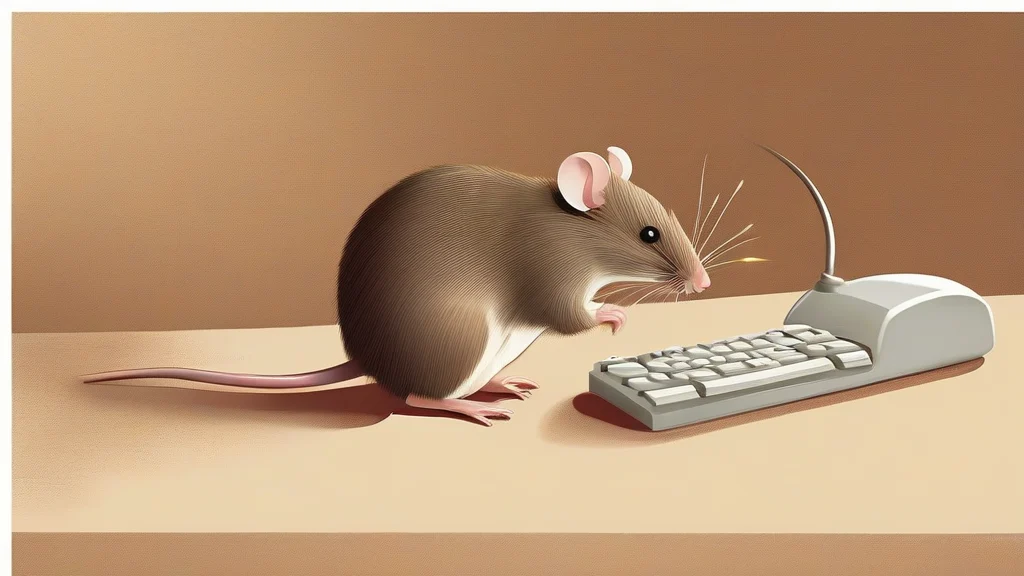
What does mouse mean?
A mouse is a small, usually nocturnal mammal with a pointed face, small ears, and a long tail, familiar in many homes as a household rodent. The same word also names a computer input device that moves a pointer around the screen, so that a user can open programs, select text, and interact with digital interfaces. The two meanings are linked by the animal’s shape: early computer devices were imagined as little creatures scurrying across a desk. In ordinary conversation, “mouse” without qualification usually means the animal, while “computer mouse” or “wireless mouse” clearly indicates the device. The word is also memorable linguistically because Latin musculus, the source of “muscle,” literally means “little mouse,” a reference to the muscle’s shape.
A small, typically nocturnal mammal of the rodent family, with a pointed snout, small ears, and a long tail.
"The little mouse ran along the kitchen counter."
The unqualified form commonly refers to the house mouse or a similar small rodent.
A handheld input device used to control the movement of a pointer on a computer screen.
"He connected the mouse to the laptop and began editing the document."
Common alternatives in formal or technical contexts include “pointing device” and, for a specific type, “trackball.”
To move or guide a computer pointer with a mouse, or to move cautiously and furtively.
"She moused through the spreadsheet, looking for the final total."
The computing sense is informal and generally used in descriptions of on-screen activity; the animal-related sense is less common.
The standard plural is “mice”; the plural pronunciation is /maɪs/.
"Several mice were hiding near the grain stores."
The computer mouse was named for its resemblance to the small animal, while the word muscle comes from Latin musculus, meaning “little mouse,” referring to the muscle’s shape.
Reviewed by Deb Chak, Editor. AI-assisted content curated by RJS Tech Solutions LLP.
Where does mouse come from?
The English word comes from Old English mous, meaning a small rodent. It was borrowed into Latin as mus, and the Latin word contributed to several forms in other European languages. The computing sense developed in the twentieth century because the device was perceived as scurrying across the desk like a small animal. The word “muscle” is related through Latin musculus, literally “little mouse,” from the resemblance of a flexing muscle to a tiny animal.
Related word forms
How mouse is actually used
In the animal sense, the word is common and neutral. In the computing sense, it is standard technical terminology; in British English, the older term “mouse” is sometimes contrasted with a trackball or pointing device.
Easily confused with mouse
A mouse is an animal or a computer input device, whereas mousse is a smooth, airy dessert or a styling product.