
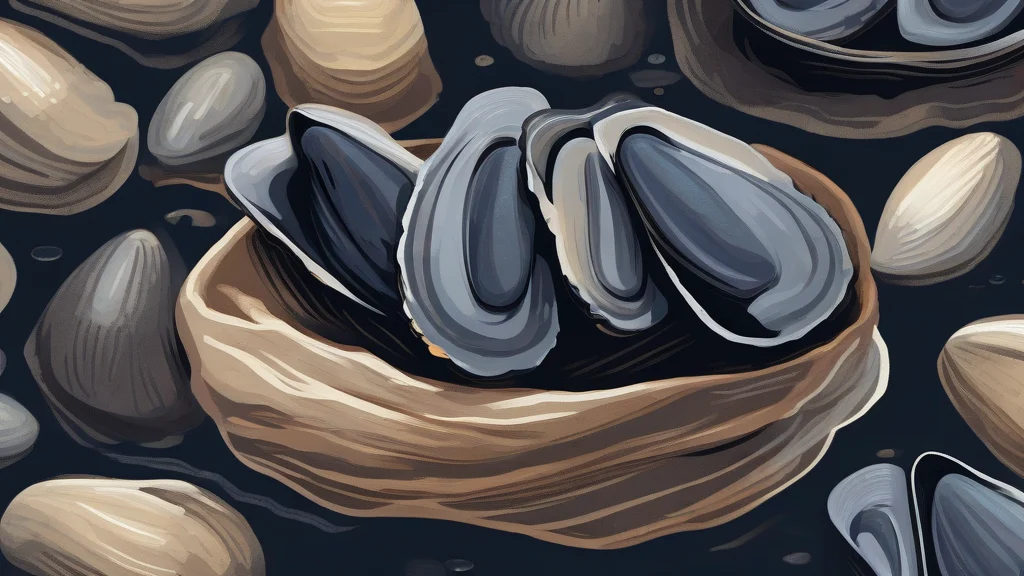
What does mussel mean?
A mussel is a small, edible mollusk belonging to the bivalve group, meaning that its body is enclosed between two hinged shells. Mussels live in both saltwater and freshwater and are usually attached to submerged surfaces by tough, threadlike structures called byssal threads. They are commonly eaten throughout Europe, including in the Netherlands, France, Spain, and Portugal, and are also popular in North America. The plural of the word is mussels, with two l’s in standard British spelling; related inflected forms commonly appear as musselled and musselling. In culinary contexts, the word often appears with terms such as steamed mussels or mussel pasta, while mussel beds refers to an area where wild mussels grow abundantly. Although mussels and clams are both bivalves, they differ in shape, structure, and often in the ways they are prepared.
nounA mollusk with two hinged shells, typically found in coastal waters or freshwater, and often eaten as food. A mussel may attach firmly to rocks, piers, or other surfaces by its byssal threads.
- An edible bivalve mollusk with two hinged shells, living in marine or freshwater environments.
"She served steamed mussels with lemon and parsley."
"The fishermen collected mussels from the rocks along the harbor."
"This recipe uses mussels, clams, and white fish in a creamy sauce."
The standard plural is mussels, with two l’s.
"The restaurant serves mussels in a white-wine sauce."
Mussels can anchor themselves to rocks and ships with tiny, threadlike cables strong enough to withstand powerful waves.
Reviewed by Deb Chak, Editor. AI-assisted content curated by RJS Tech Solutions LLP.
Where does mussel come from?
The word comes through Middle English from Old English muscle, which was borrowed from Latin musculus. Latin musculus could refer both to a muscle and to a mussel, probably because the shellfish resembles a small muscle. The modern English spelling with double s reflects the later Middle English form, while muscle continues to represent the related sense associated with physical strength.
Related word forms
How mussel is actually used
The term is used in British and American English. In British usage, the plural can be spelled either mussels or mussels, and the related past-tense forms are commonly written musselled and musselling; American usage usually uses musseled and musseling, although mussels is also standard. “Mussel” is not normally used for the similar-looking but unrelated plant called mussel tree.
Easily confused with mussel
A mussel is a bivalve mollusk, but it is generally smaller and more elongated than a clam, and it commonly attaches to surfaces by strong threads.
An oyster is also a bivalve mollusk, but it has a rough, irregular shell and is typically eaten raw, whereas mussels are usually elongated and commonly steamed or boiled.