
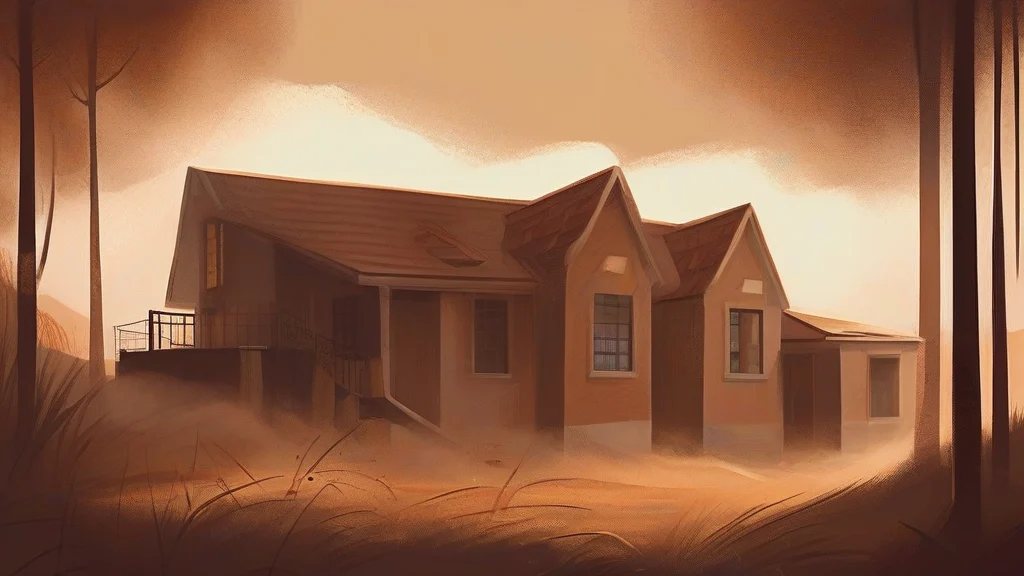
What does house mean?
House most commonly names a building where people live, or the dwelling itself as a home. Its meaning can extend from the physical structure to the people who inhabit it, so that “the house” may refer to a household, a family, or an aristocratic lineage. The word also names buildings and institutions connected with particular purposes, such as an opera house, a publishing house, or a house of worship. In political language, a House is a legislative chamber or the assembly associated with it. As a verb, “to house” means to provide accommodation or shelter, or to place something in a suitable building. As an adjective, it can describe music, style, or arrangements associated with a house, household, or establishment. House is therefore both a precise label for a kind of building and a flexible vocabulary word for the structures, families, organizations, and traditions in which people live and work. Its long history and broad range of uses make it one of English’s most familiar words.
A building or part of a building used as a dwelling; by extension, a household, family, institution, venue, or legislative chamber.
"The family moved into a new house at the edge of town."
When referring to a legislature, capitalization is common in names such as “the House of Representatives” and “the House of Commons.”
To provide with accommodation or shelter; to place or keep something in a house or suitable building.
"The museum housed its collection in a converted warehouse."
The verb is transitive: “to house someone” or “to house a collection.”
Relating to a house, household, or associated establishment; used especially in expressions such as “house music,” “house style,” and “house rules.”
"The band became known for its energetic house music."
This use is normally attributive rather than predicative: “house music” is standard, while “the music is house” is uncommon.
The plural is formed by adding -s. Use “a household” when referring to the people living in one house rather than to the building itself.
"The street is lined with houses and small gardens."
From the Old English word for a dwelling to the homes, families, venues, and institutions we call houses today, this simple word has shaped the way English describes the places where life happens.
Reviewed by Deb Chak, Editor. AI-assisted content curated by RJS Tech Solutions LLP.
Etymology of house
House descends from Old English hūs, meaning a dwelling or building. The Old English word was inherited from Proto-Germanic *hūsą and is cognate with German Haus, Dutch huis, Swedish hus, and Icelandic hús. The modern verb developed by applying a verbal use to the noun: to house something originally meant to shelter or place it in a house, and the verb later broadened to mean to provide accommodation.
Related word forms
How house is actually used
In British and American English, “house” is generally neutral for a residential building. It can suggest a family or household when referring to a person’s place or lineage, as in “the royal house.” In political contexts, a capitalized “House” commonly refers to a legislative chamber. As an adjective, “house” is usually used attributively, especially in expressions such as “house music” and “house style.”
Easily confused with house
A house is a building or dwelling, whereas a horse is an animal often kept in a stable or paddock.