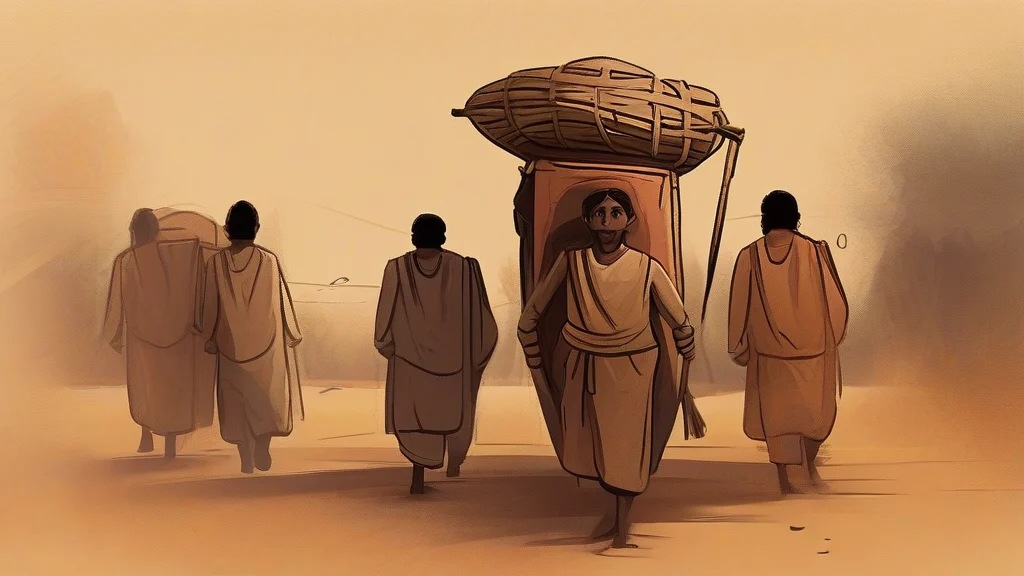
What does doolie mean?
A doolie is a covered litter or palanquin, carried on poles on the shoulders of several bearers, used to transport a seated or reclining person. The word is closely associated with British India, where doolies served as a practical means of conveyance through terrain unsuited to wheeled vehicles, and they were widely employed to carry sick or wounded soldiers, officials, and travellers. In military contexts the term could apply broadly to any stretcher-like carrier used for casualties. Today the word survives mainly in historical accounts, memoirs, and fiction set in the colonial era, and it carries an unmistakably period flavour: to read of someone being conveyed in a doolie is to be placed squarely in nineteenth-century India. Alternative spellings such as "dhooly" appear frequently in older sources.
nounA doolie is a covered litter or palanquin used for carrying a person, especially in India, borne on the shoulders of bearers by means of poles.
- A covered litter or palanquin carried on poles by bearers, used especially in India.
"The wounded officer was carried down from the hills in a doolie by six bearers."
"The maharaja travelled to the ceremony in a gilded doolie."
"Stretchers and doolies ferried the injured from the battlefield to the field hospital."
Regular plural; older texts may use variant spellings such as dhoolies.
"A procession of doolies wound its way down from the ridge at dawn."
Before ambulances and railways crisscrossed India, wounded soldiers travelled to hospital in a doolie — a bed swung between men's shoulders.
Reviewed by Deb Chak, Editor. AI-assisted content curated by RJS Tech Solutions LLP.
Etymology of doolie
Doolie entered English during the era of British involvement in India, borrowed from Hindi ḍolī, meaning a swing, litter, or palanquin, which itself derives from a Sanskrit root connected with swinging or swaying motion. It became established in Anglo-Indian vocabulary in the eighteenth and nineteenth centuries, particularly in military and administrative usage, before receding with the decline of manual litters.
Related word forms
How doolie is actually used
The word belongs chiefly to historical writing about colonial India and appears rarely in modern speech. Spellings vary, with "dhooly" and "dooly" found in older texts.
Easily confused with doolie
"Doolally" is an informal adjective meaning mad or eccentric (from the Deolali military camp), while "doolie" is a noun denoting a litter or palanquin.