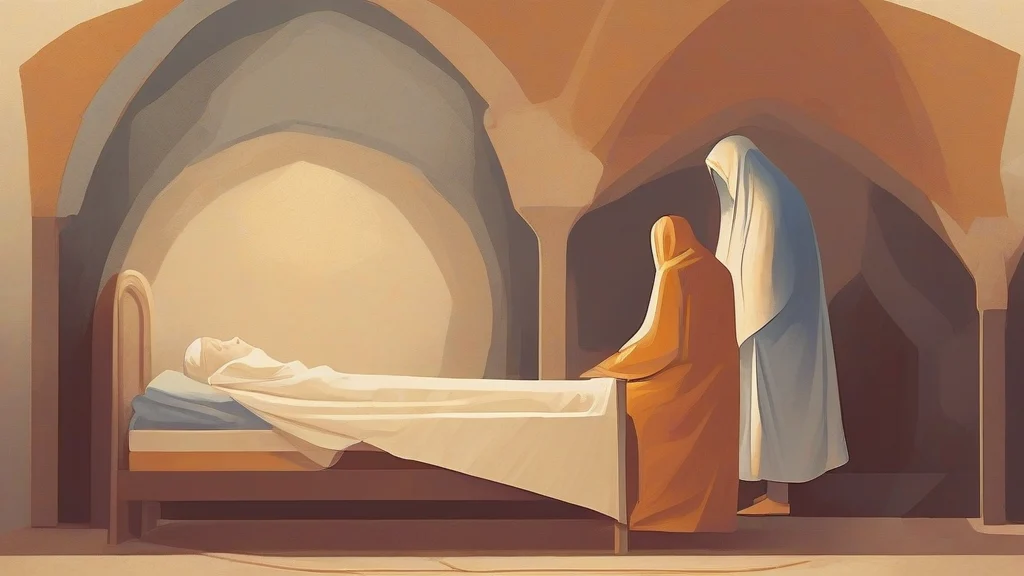
What does dormition mean?
Dormition is a noun that derives from the Latin verb dormire, 'to sleep', and literally means the act of falling asleep. Although its plain sense of 'sleep' survives only in literary and ecclesiastical registers, the word is best known today through its capitalized religious use: the Dormition of the Virgin Mary refers to her death as understood in Eastern Orthodox and Eastern Catholic tradition, where dying is described tenderly as falling into sleep before bodily assumption into heaven. The Feast of the Dormition, observed on 15 August, is one of the great celebrations of the Orthodox liturgical year, preceded by a two-week period of fasting known as the Dormition Fast. Countless icons and frescoes depict the scene of Mary reclining while Christ receives her soul. Because of this association, dormition carries a serene, hallowed tone — a gentle euphemism for death rather than a clinical one — making it a strikingly poetic term for anyone interested in theology, art history, or the language of mortality.
nounThe act of falling asleep or the state of sleep; in religious usage, capitalised as Dormition, it refers specifically to the death of the Virgin Mary, regarded in Eastern Orthodox and some other Christian traditions as a peaceful passing into eternal life.
- In Christian theology, especially Eastern Orthodoxy, the death of the Virgin Mary, commemorated as the Feast of the Dormition.
- Literary or formal: the act of falling asleep; sleep.
"The icon of the Dormition depicts the Virgin Mary surrounded by the apostles at her final rest."
"Orthodox churches celebrate the Feast of the Dormition on 15 August."
"In his poem, night's dormition settles over the weary village."
Rarely pluralized; the plural appears only in references to multiple depictions, feasts, or instances across different traditions or artworks.
"Byzantine manuscripts preserve many vividly painted dormitions from the medieval period."
In Eastern Christianity, the death of the Virgin Mary is never called her death — she is said to have 'fallen asleep', which is exactly what dormition literally means.
Reviewed by Deb Chak, Editor. AI-assisted content curated by RJS Tech Solutions LLP.
Etymology of dormition
Dormition comes from Latin dormitio, meaning 'a sleeping', formed from the verb dormire ('to sleep'), the same root behind English words such as dormant, dormitory, and dormant's cousin somnolent via the related Proto-Indo-European root *drem-. The word entered English in the late medieval/early modern period largely through its use in describing the Dormition of the Virgin Mary, a title long established in Greek Christian tradition as Koimēsis, also meaning 'falling asleep'. Its everyday sense of ordinary sleep has since faded, leaving the word almost exclusively tied to its sacred usage.
How dormition is actually used
Lower-case 'dormition' is rare and chiefly literary, meaning sleep. In nearly all modern usage the word appears capitalized as 'Dormition' with reference to the Virgin Mary, and it carries a reverent, solemn connotation — the euphemistic sense of 'falling asleep' rather than dying. It is most familiar within Eastern Orthodox and Eastern Catholic contexts; Western traditions more often speak of the Assumption.
Easily confused with dormition
Dormition is a noun meaning sleep or the Virgin Mary's death, while dormitive is an adjective (or noun) describing something that induces sleep.