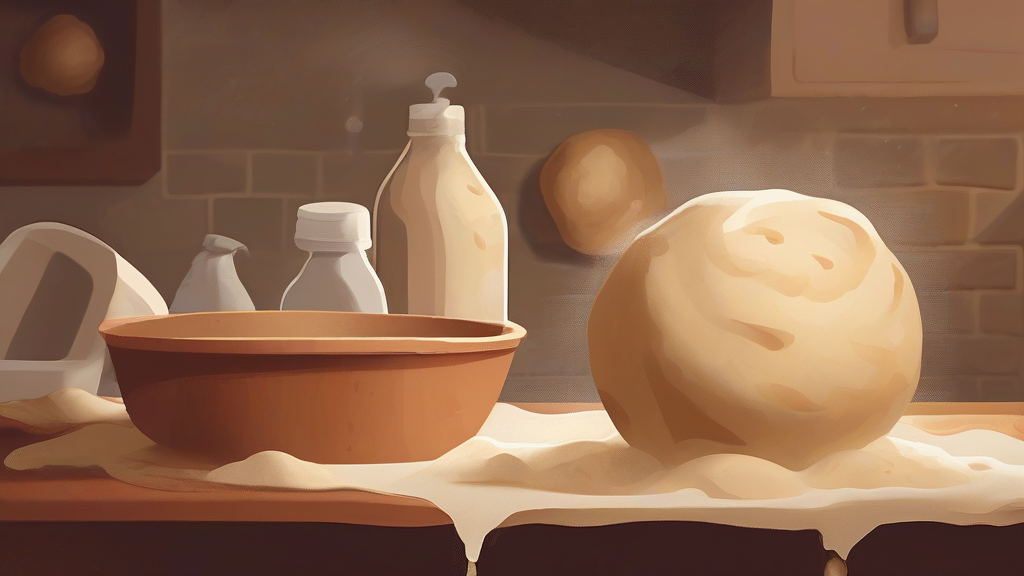
What does dough mean?
Dough is a soft, malleable mixture of flour and liquid — usually water or milk — that is kneaded into shape and baked to produce bread, rolls, pastries, pizza bases, and cookies. Unlike a batter, which is pourable, dough is stiff enough to be worked by hand, and its texture depends on ingredients such as yeast, butter, or sugar. The word is central to cooking vocabulary worldwide, appearing in countless fixed phrases like 'knead the dough' and 'roll out the dough'. Beyond the kitchen, dough carries a well-established informal sense meaning money, especially in American English, where someone might say they need to earn some extra dough. This figurative use arose in nineteenth-century America and parallels similar food-based slang like 'bread'. The adjective form is doughy, describing something soft and pale, whether literal dough or a person's complexion. Simple, concrete, and versatile, dough is among the most useful everyday words in English.
A soft, thick mixture of flour and liquid, kneaded and used as the base for baked goods such as bread, pastry, and cookies.
"Cover the dough with a cloth and leave it in a warm place to rise."
In this sense dough is uncountable, though 'a dough' can refer to a particular batch.
Money, especially in informal contexts.
"That car must have cost a lot of dough."
Colloquial; chiefly American, though widely understood.
Rarely pluralized except when referring to different kinds or batches of dough, e.g. in baking contexts.
"The bakery works with several different doughs each morning."
Before 'bread' meant money, 'dough' did — English speakers have been calling cash dough since the mid-1800s.
Reviewed by Deb Chak, Editor. AI-assisted content curated by RJS Tech Solutions LLP.
Etymology of dough
Dough descends from Old English dāh or dāg, meaning the mixture of flour and water used for bread, which traces back through Proto-Germanic *daigaz to the Proto-Indo-European root *dheigh-, meaning 'to form, knead, or mould'. That same root produced a striking family of cognates: Latin fingere ('to shape', source of figure and fiction), Old English dǣg ('female', originally 'one who suckles'), and dairy, from Old Norse deig ('dough') combined with hús ('house'). The word has been stable in both form and meaning across more than a thousand years of English.
Related word forms
How dough is actually used
The money sense is informal and colloquial, common in American speech; the baking sense is standard everywhere.
Easily confused with dough
A dhow is an Arab sailing vessel, whereas dough is a flour-and-liquid mixture (or slang for money); the two differ in spelling and meaning despite similar sound.
A doe is a female deer, pronounced identically to dough but spelled differently and referring to an animal.