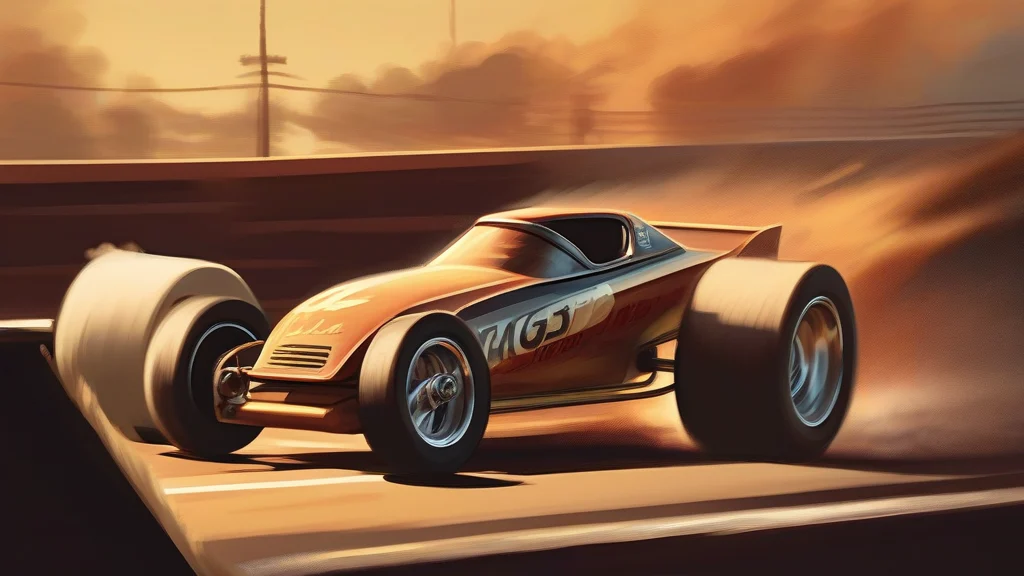
What does dragster mean?
A dragster is a purpose-built automobile engineered for maximum acceleration over a short, straight course — usually a quarter mile — in the motorsport known as drag racing. Unlike ordinary race cars designed for corners and endurance, a dragster prioritizes raw straight-line speed: long wheelbase, minimal bodywork, enormous rear tires, and engines producing thousands of horsepower in the fastest classes. The word functions as a noun and belongs firmly to automotive and sporting vocabulary; it appears constantly in motorsport coverage and enthusiast writing, often paired with class names like "top fuel dragster." The term carries connotations of power, noise, and spectacle, evoking the smoke-and-thunder atmosphere of the drag strip. Though rooted in American racing culture, it is widely understood across English-speaking countries. For anyone following motorsport, reading automotive history, or simply describing an extremely fast straight-line machine, "dragster" is the precise and standard term.
nounA dragster is a specially built automobile designed for acceleration and speed over a short, straight course, typically a quarter mile, in drag racing.
- A specialized automobile built for competing in drag races, especially over a quarter-mile straight track.
"The top-fuel dragster roared down the strip at over 330 miles per hour."
"She spent two years building her own dragster in the family garage before entering her first amateur race."
"The museum's exhibit featured a restored 1960s front-engine dragster alongside modern top fuel machines."
Standard regular plural. Used both for multiple vehicles and generically for the category.
"Dozens of dragsters lined up behind the starting line for qualifying runs."
Top fuel dragsters can hit 100 mph from a standing start in under one second — faster than most fighter jets on takeoff.
Reviewed by Deb Chak, Editor. AI-assisted content curated by RJS Tech Solutions LLP.
Etymology of dragster
Dragster combines "drag" — used since the mid-20th century to mean a short straight-line speed contest, itself likely from earlier senses of drag as a road or course (as in "main drag") — with the agentive suffix "-ster," indicating a person or thing associated with an activity. It arose in American English alongside organized drag racing in the late 1940s and 1950s. The suffix "-ster" also appears in words like "gangster" and "hipster."
How dragster is actually used
Register: neutral to technical; common in motorsport journalism and enthusiast circles. Strongly associated with American drag-racing culture, though understood internationally. Often modified by class names such as "top fuel", "funny car", or "pro stock" when referring to specific competition categories.
Easily confused with dragster
"Drag" is the act or force of pulling something along (or aerodynamic resistance), while a "dragster" is specifically a vehicle built for straight-line speed contests.