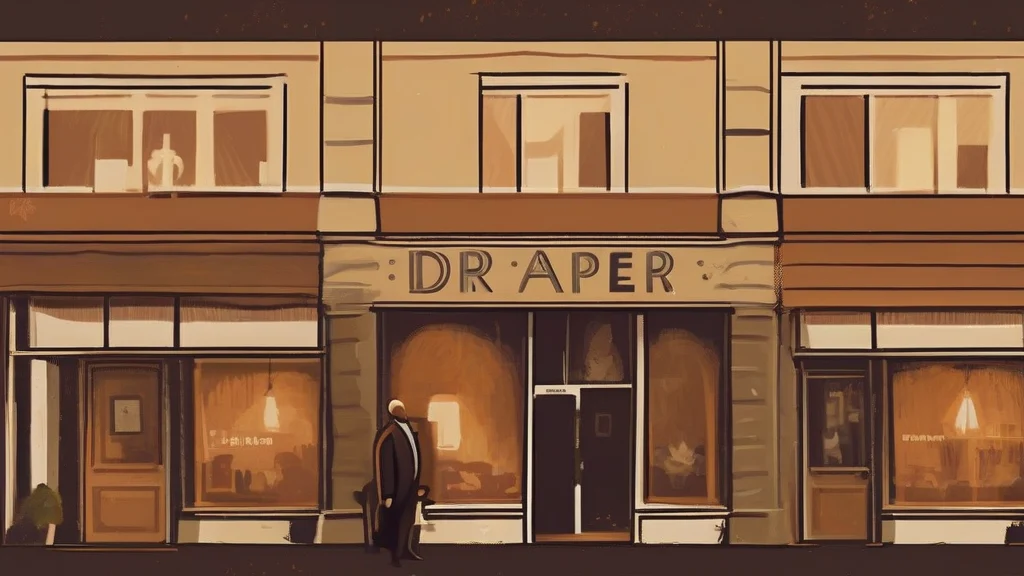
What does draper mean?
A draper is a dealer in cloth and textiles — historically a merchant of woolen cloth and later the proprietor of a shop selling fabrics, sewing materials, and household linens. The word belongs primarily to British English and carries an old-fashioned, evocative quality: the high-street draper's shop was once a fixture of every town, its shelves stacked with bolts of calico, muslin, and flannel. Today the term has largely receded from everyday speech, surviving in institutional names such as London's Worshipful Company of Drapers — a livery company dating to the fourteenth century — and in the common surname Draper, which began as an occupational name for those in the trade. Related forms include drapery, meaning both the trade itself and the fabrics sold. For readers of older fiction or social history, knowing this word illuminates a world of commerce in which cloth was among the most valuable commodities traded.
nounA draper is a dealer in cloth and fabrics, especially one who owns or works in a shop selling textiles and sewing goods; the term is now chiefly British and somewhat old-fashioned. In historical usage it also denoted a merchant of woolen cloth.
- A person who sells cloth and fabrics, especially as the proprietor of a draper's shop.
- (Historical) A merchant dealing in woolen cloth in medieval and early modern England.
"Her grandmother worked as a draper in a small shop on the high street, measuring out calico by the yard."
"The village draper stocked everything from linen to lace, and everyone knew him by name."
"In Chaucer's London, a successful draper could rise to become an alderman or even mayor."
Standard regular plural. The capitalized form "Drapers" appears in the name of London's Worshipful Company of Drapers.
"Medieval drapers often held considerable civic power in English towns."
London's Drapers' Company, founded in the 1300s, still exists today — one of the great livery companies born from the medieval cloth trade that gave us the word "draper."
Reviewed by Deb Chak, Editor. AI-assisted content curated by RJS Tech Solutions LLP.
Etymology of draper
Draper derives from the Anglo-French and Old French word "drap," meaning cloth, which itself traces back through Medieval Latin "drappus." The English word entered use in the medieval period to denote a merchant who dealt in woolen cloth, at a time when the wool trade was central to the English economy. From the same root come "drape" and "drapery," and the occupational surname Draper preserves the trade in name form.
How draper is actually used
The word is now largely dated and British; modern shops would more likely be called fabric shops or haberdasheries, and the person a shopkeeper or textile merchant. It survives in institutional names such as the Worshipful Company of Drapers in London and in the surname Draper, which originated as an occupational name.
Easily confused with draper
"Draper" is the person who deals in cloth, while "drapery" refers to the cloth or curtains themselves, or the trade collectively.
A haberdasher sells small sewing notions such as buttons, thread, and ribbons (in British usage), whereas a draper sells cloth and fabric.