
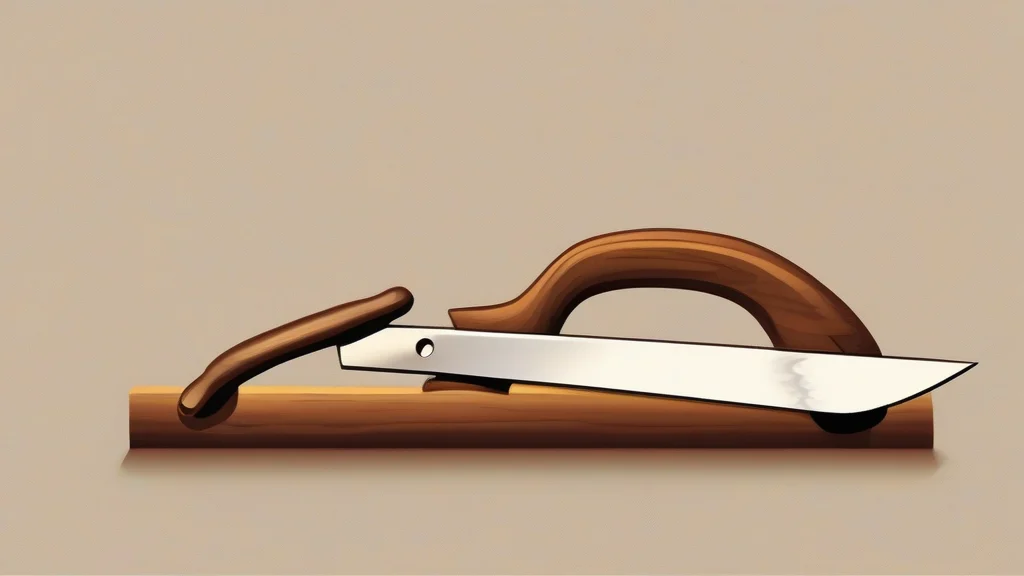
What does drawknife mean?
A drawknife is a traditional woodworking hand tool consisting of a straight or slightly curved blade with a handle at each end, designed to be pulled toward the user rather than pushed away. By drawing the blade across a piece of wood — usually clamped in a vice or held on a shave horse — the craftsperson can remove bark, shave off thin layers, round over edges, or roughly shape components such as chair spindles, tool handles, and barrel staves. The drawknife is central to green woodworking and traditional trades such as coopering and wheelwrighting, where speed and control in removing waste wood matter more than a fine finish, which is typically achieved afterwards with a spoke shave or plane. Because it is pulled rather than pushed, it demands a firm grip and careful attention to grain direction. Though largely replaced by power tools in industrial settings, it remains prized by hand-tool enthusiasts for its immediacy, versatility, and the tactile connection it offers between maker and material.
nounA woodworking tool consisting of a blade with a handle at each end, used by pulling it toward the user to shave or shape wood.
- A woodworking hand tool with a blade set at right angles to two handles at either end, drawn toward the user to shave, debark, or shape wood.
"He roughed out the chair spindles with a drawknife before refining them with a spoke shave."
"Using long, even strokes, she peeled the bark from the log with a drawknife."
"Traditional cooperages still rely on the drawknife to taper staves by hand."
Regular plural formation; the 'f' does not change to 'ves' because it is preceded by a vowel sound in the compound's final element.
"The workshop had several drawknives of different widths hanging on the wall."
The drawknife works entirely in reverse: instead of pushing the blade away like most tools, you haul it toward your own chest — trusting the wood more than your reflexes.
Reviewed by Deb Chak, Editor. AI-assisted content curated by RJS Tech Solutions LLP.
Where does drawknife come from?
Drawknife is a straightforward English compound formed from the verb 'draw' (from Old English dragan, meaning to pull or drag) and 'knife' (from Old Norse knifr). The name literally describes its defining action: a knife that is drawn toward the user. The compound arose within English craft vocabulary, likely during the medieval or early modern period as woodworking trades developed specialised terminology, and cognate compounds such as German Zugmesser ('pull-knife') reflect the same descriptive logic across languages.
How drawknife is actually used
A specialist term used mainly among woodworkers, green-wood carvers, coopers, and chair makers; rare in everyday speech. Sometimes written as the closed compound 'drawknife' or as the open form 'draw knife', though 'drawknife' is standard. Also called a draw shave or shaving knife.
Easily confused with drawknife
A drawknife is pulled toward the user and has two handles, while a spoke shave has a short body held in one or both hands and is typically pushed.