
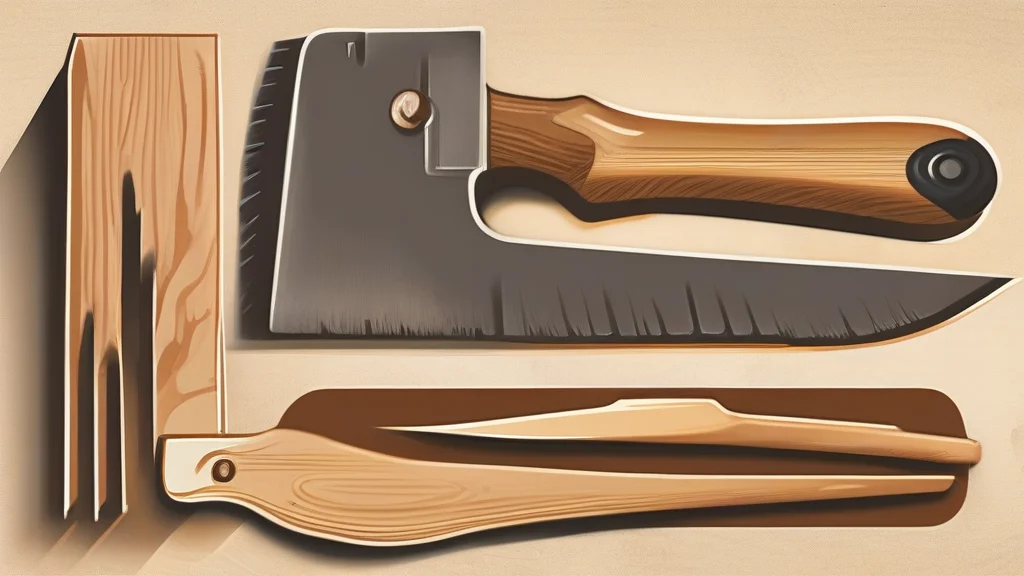
What does drawshave mean?
A drawshave is a traditional woodworking hand tool consisting of a single-edged blade fitted with a handle at each end. The craftsman holds one handle in each hand and draws the tool toward himself across the surface of the wood, shaving off thin layers to shape, smooth, or taper it. Because the cut is controlled entirely by the pull of the hands rather than by a fixed guide, the drawshave rewards practice and a sensitive touch, making it a favorite among green-wood carvers, chairmakers, coopers, and other practitioners of traditional trades. It is typically used on a shaving horse, which clamps the workpiece while leaving both of the worker's hands free. In modern English the tool is more often called a drawknife, with "drawshave" surviving as a chiefly American variant favored by traditional woodworkers. The word transparently combines "draw" and "shave," describing exactly how the tool is used.
nounA drawshave is a woodworking hand tool consisting of a blade with a handle at each end, pulled toward the user to shave or smooth wood. It is more commonly known as a drawknife.
- A woodworking hand tool with a single-edged blade and a handle at each end, drawn toward the user to shave, shape, or smooth wood; also called a drawknife.
"Using the drawshave, he pared thin curls of wood from the chair leg until the curve sat perfectly in his palm."
"He roughed out the spoon blank with a hatchet before finishing it with a drawshave."
"In the cooperage, apprentices learned to true up staves using nothing but a drawshave and a shaving horse."
Regular plural formation; used when referring to multiple tools or to a workshop's stock of them.
"The tool wall held an assortment of drawshaves in every width and curvature."
The drawshave works entirely against instinct: instead of pushing the blade away from you like most tools, you pull it toward your own body — and that's exactly what gives you control.
Reviewed by Deb Chak, Editor. AI-assisted content curated by RJS Tech Solutions LLP.
Where does drawshave come from?
Drawshave is a straightforward English compound formed from the verbs "draw" and "shave," first recorded in American usage in the nineteenth century. Both elements are ancient Germanic words: "draw" descends from Old English dragan, meaning to pull or carry, while "shave" comes from Old English sc(e)afan, to scrape or pare. The compound names the tool's defining action — pulling (drawing) the blade so that it shaves the wood. Cognates of its parts appear throughout the Germanic languages, such as German tragen (to carry), from the same root as "draw," and Dutch schaven (to plane or shave).
How drawshave is actually used
"Drawshave" is chiefly an American term and is somewhat less common than "drawknife," which is now the standard name for this tool in both British and American usage. The word belongs mainly to traditional woodworking, green-wood carving, and historical trades such as coopering and wheelwrighting.
Easily confused with drawshave
A drawshave is pulled with both hands toward the user and has no fixed blade depth, whereas a spokeshave has handles mounted on either side of the blade with a set cutting angle for finer, controlled shaping.
A drawshave is drawn across the wood by hand without a sole to regulate depth, while a plane has a flat base that limits how much material is removed.