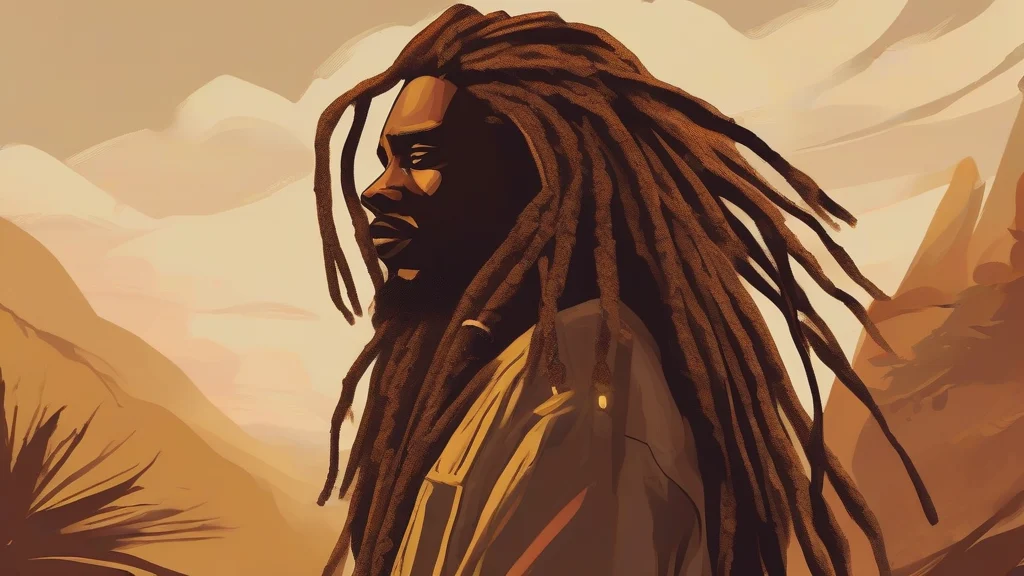
What does dreadlock mean?
A dreadlock is a strand of hair that has been allowed to mat and twist into a rope-like form, typically one of many worn close to the scalp. Usually discussed in the plural, dreadlocks are most closely associated with Rastafarian culture, where the hairstyle carries spiritual significance, though they have been worn across many cultures and historical periods and are now a mainstream fashion choice worldwide. Forming true dreadlocks requires patience — the hair is encouraged (or simply left) to tangle and knot over months or years until each strand holds a firm, cylindrical shape. The word combines 'dread', in the older sense of awe or reverence for God, with 'lock', meaning a curl or tress of hair. Because the prefix 'dread-' can sound alarming to those unfamiliar with this origin, some wearers prefer the shorter term 'locs'.
nounA lock of hair that has been allowed to grow into a long, ropelike tangle, typically formed by matting or braiding and worn especially in the Rastafarian hairstyle of the same name.
- A single ropelike strand of hair matted into a twisted form, usually one of many worn together.
- (collectively) The full head of such strands, as a hairstyle associated particularly with Rastafarianism and adopted widely across cultures.
"She wore her dreadlocks gathered loosely at the nape of her neck."
"It took him nearly three years to grow his dreadlocks to shoulder length."
"The musician's long grey dreadlocks swung as he leaned over the guitar."
The plural is the standard form when referring to the hairstyle collectively; the singular is reserved for a single strand.
"Her dreadlocks reached her waist after nearly a decade of growth."
The word 'dread' in 'dreadlock' originally referred to the 'dread' or fear of God worn by Rastafarians as a sign of devotion — not to anything frightening about the hair itself.
Reviewed by Deb Chak, Editor. AI-assisted content curated by RJS Tech Solutions LLP.
Etymology of dreadlock
The word 'dreadlock' arose in the mid-20th century within Rastafarian communities in Jamaica, combining 'dread' — used by Rastafarians to denote reverence or awe toward God (the 'dread' or 'dreadful' being a righteous person feared for their holiness) — with 'lock', an old English word for a tress or curl of hair. The hairstyle itself has much deeper roots, appearing in ancient Egyptian, Indian, and other early cultures, but the specific English term is tied to the Rastafarian movement's growth and global visibility from the 1960s onward.
How dreadlock is actually used
Usually used in the plural ('dreadlocks'), even when referring to the style as a whole. The singular 'a dreadlock' refers to one individual strand. The term originated within Rastafarian culture; some speakers now prefer 'locs' or 'locks', finding 'dread' an unwanted negative connotation outside its original religious sense.
Easily confused with dreadlock
A 'lock' is any coil or ringlet of hair, while a 'dreadlock' is specifically a rope-like strand of matted hair.
A braid is hair woven together in an interlaced pattern, whereas a dreadlock forms naturally through matting rather than deliberate weaving.