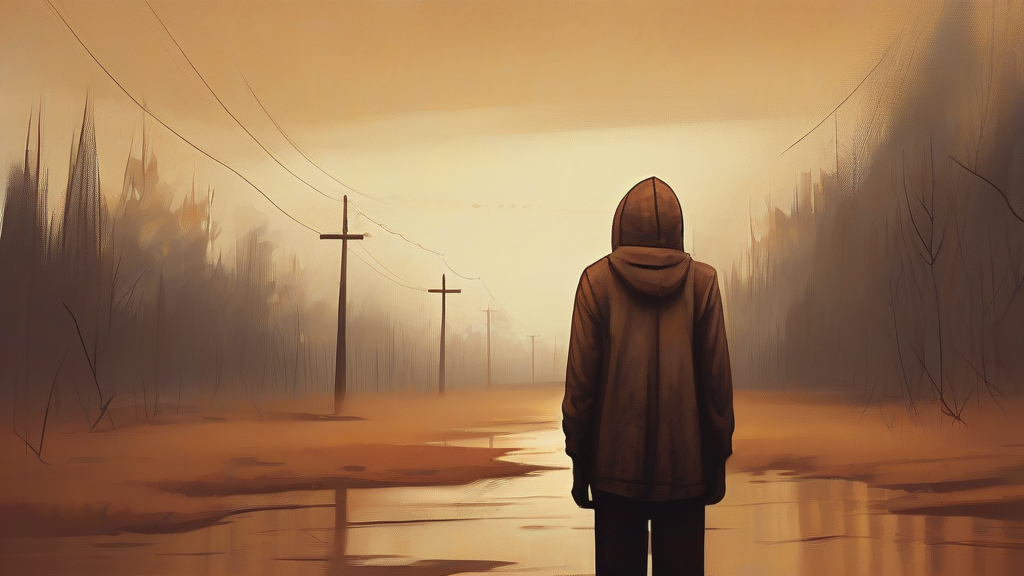
What does drearihood mean?
Drearihood is a rare, literary noun meaning the state or quality of being dreary — a condition of gloom, dullness, or oppressive monotony. It is formed from the adjective 'dreary' combined with the suffix '-hood', which typically turns adjectives or nouns into abstract nouns denoting a state or condition, as in 'childhood' or 'falsehood'. In practice, the word appears most often in older or self-consciously literary writing, where it lends a slightly heightened, almost wistful gravity to descriptions of grey weather, tedium, or spiritual flatness: one might speak of the drearihood of a November afternoon or of routine office work. In modern usage it has largely been supplanted by the more common 'dreariness', which carries the identical meaning without the archaic flavour. Drearihood survives chiefly as a stylistic choice, valued for its evocative weight rather than its precision.
nounThe state or quality of being dreary; dullness, gloominess, or depressing monotony.
- The state or quality of being dreary: dullness, gloominess, or depressing sameness of atmosphere or circumstance.
"The endless rain and empty streets deepened the drearihood of the seaside town in November."
"November fog settled over the harbour, wrapping the town in its usual drearihood."
"He wrote wearily of the drearihood of office life, its grey routines unbroken by any spark of joy."
Almost never pluralized; the word denotes an abstract state and normally appears only in the singular.
"He had known many drearihoods in his long exile, but none quite so heavy as this."
Drearihood takes the humble word 'dreary' and gives it the grand suffix of 'motherhood' and 'childhood' — as if gloom itself were a stage of life you could belong to.
Reviewed by Deb Chak, Editor. AI-assisted content curated by RJS Tech Solutions LLP.
Etymology of drearihood
Drearihood is formed from the adjective 'dreary', which descends from Old English 'drēorig' meaning 'bloody, sad, grievous' — originally derived from 'drēor', blood, so that to be dreary was literally to be blood-spattered or gory before the sense softened to 'sad, dismal'. The suffix '-hood' comes from Old English '-hād', denoting state or condition. The compound arose in English prose, likely in the early modern period, alongside parallel formations like 'wearihood'. Its cognates are essentially the other derivatives of 'dreary', such as 'drear' and 'drearily'.
How drearihood is actually used
A rare and markedly literary word, more likely to be found in 19th-century prose than everyday speech. The ordinary term 'dreariness' has largely displaced it. Its tone is often faintly wry or self-consciously elevated.
Easily confused with drearihood
Dreariness is the far more common word for the same quality, while drearihood is a rarer, more literary variant built with the suffix -hood.