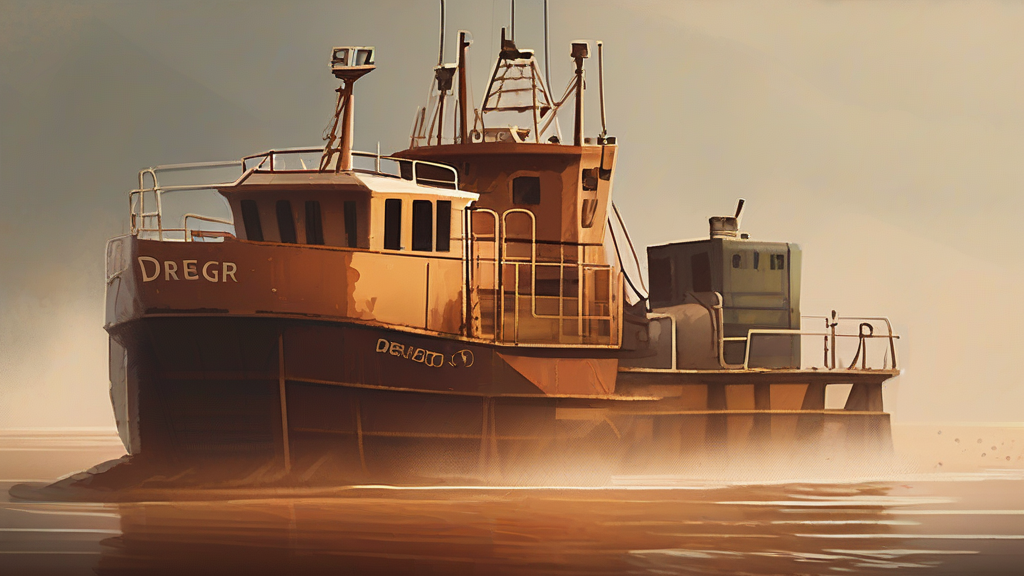
What does dredger mean?
A dredger is a specialised vessel or machine designed to remove sediment — mud, sand, silt, or gravel — from the beds of rivers, harbours, canals, and coastal waters. Dredgers keep shipping channels deep enough for large vessels, reclaim land from the sea, extract construction materials, and restore beaches. They come in many forms: cutter suction dredgers grind and pump material through pipes, bucket dredgers scoop it mechanically, and trailing suction hopper dredgers vacuum sediment into onboard holds as they move. The word can also denote a person who operates such equipment, though this sense is now less common than the machine itself, and in British English it names a household perforated container for dusting food with flour or sugar. The term derives from 'dredge', whose origins lie in Middle English, likely connected to words meaning to drag or draw. Familiar mainly in maritime and engineering contexts, 'dredger' is a precise, technical noun that captures humanity's long effort to reshape waterways.
A ship or floating machine equipped to excavate and remove sediment from the bed of a body of water.
"The port authority hired a dredger to deepen the approach channel."
This is by far the dominant sense in both British and American English, especially in maritime and civil-engineering contexts.
A person who operates a dredge or works on a dredging vessel.
"His grandfather spent thirty years as a dredger on the Mersey."
(British English) A perforated container used for sprinkling flour, sugar, or other powders over food.
"Give the pastry a light dusting of icing sugar using the dredger."
Chiefly British and somewhat traditional in register.
Standard regular plural, applied equally to vessels, machines, operators, and kitchen utensils.
"Two dredgers worked side by side at the harbour entrance all summer."
Some modern trailing suction hopper dredgers can vacuum up enough sand in one day to fill an Olympic swimming pool dozens of times over — they literally built the islands of Dubai.
Reviewed by Deb Chak, Editor. AI-assisted content curated by RJS Tech Solutions LLP.
Etymology of dredger
Dredger was formed by adding the agentive suffix '-er' to the verb 'dredge', which appeared in English in the late fifteenth century meaning to dig or scoop out mud from a riverbed. The deeper origin of 'dredge' is uncertain, though it is often linked to Middle English and Scots terms related to dragging or drawing things along. As steam- and later diesel-powered vessels were developed in the nineteenth century, 'dredger' came to refer chiefly to the machines themselves rather than the men who operated them.
How dredger is actually used
In maritime and engineering contexts, 'dredger' almost always refers to the vessel or machine rather than the operator. In British domestic English the kitchen sense (a flour or sugar sprinkler) is well established but increasingly dated among younger speakers; American English typically uses 'shaker' or 'sifter' for this item.
Easily confused with dredger
A dredge is the tool or vessel itself (or the verb meaning to scoop out sediment), while a dredger is specifically the person operating it or, in most usage today, the ship or machine that does the work.